Teleostei (teleosts) >
Scombriformes (Mackerels) >
Scombridae (Mackerels, tunas, bonitos) > Scombrinae
Etymology: Scomberomorus: Latin, scomber = mackerel + Greek, moros = silly, stupid (Ref. 45335).
More on authors: Bloch & Schneider.
Environment: milieu / climate zone / depth range / distribution range
Ecology
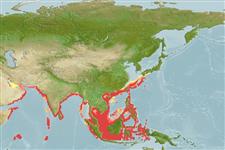
Marine; brackish; pelagic-neritic; oceanodromous (Ref. 51243); depth range 15 - 200 m (Ref. 9684), usually 20 - 90 m (Ref. 12260). Tropical; 38°N - 7°S, 49°E - 134°E (Ref. 54881)
Indo-West Pacific: Persian Gulf, India and Sri Lanka (Ref. 9684) to southeast Asia, north to Hong Kong and Wakasa Bay, Sea of Japan.
Length at first maturity / Size / Weight / Age
Maturity: Lm 39.8, range 33 - 46.5 cm
Max length : 81.5 cm FL male/unsexed; (Ref. 131628); common length : 55.0 cm FL male/unsexed; (Ref. 9684); max. published weight: 4.0 kg (Ref. 131628)
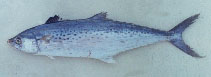
Dorsal spines (total): 15 - 18; Dorsal soft rays (total): 18 - 24; Anal spines: 0; Anal soft rays: 19 - 23; Vertebrae: 47 - 52. Interpelvic process small and bifid. Swim bladder absent. Body entirely covered with small scales. Lateral line with many auxiliary branches extending dorsally and ventrally in anterior third, curving down toward caudal peduncle. Intestine with 2 folds and 3 limbs. Sides silvery white with several rows of round dark brownish spots scattered in about three irregular rows along the lateral line. First dorsal fin membrane black.
Body shape (shape guide): fusiform / normal; Cross section: oval.
A pelagic migratory fish inhabiting coastal waters at depths between 15-200 m; sometimes entering turbid estuarine waters; usually found in small schools (Ref. 9684). Feeds mainly on small schooling fishes (especially sardines and anchovies), squids and crustaceans (Ref. 9684). Fishing peaks in the months of November and December in Eastern Thailand, late Dec and January in the northern part of the Gulf and January to March in its western part. Caught with midwater trawls, purse seines, bamboo stake traps, and by trolling (Ref. 9684). Marketed mainly fresh; also dried-salted (Ref. 9684), smoked and frozen (Ref. 9987). Small quantities of frozen product are exported to Europe and North America (Ref. 9987).
Collette, B.B. and C.E. Nauen, 1983. FAO Species Catalogue. Vol. 2. Scombrids of the world. An annotated and illustrated catalogue of tunas, mackerels, bonitos and related species known to date. Rome: FAO. FAO Fish. Synop. 125(2):137 p. (Ref. 168)
IUCN Red List Status (Ref. 130435: Version 2025-1)
Threat to humans
Harmless
Human uses
Fisheries: highly commercial; gamefish: yes
Tools
Special reports
Download XML
Internet sources
Estimates based on models
Preferred temperature (Ref.
123201): 23.6 - 29.1, mean 28.2 °C (based on 1618 cells).
Phylogenetic diversity index (Ref.
82804): PD
50 = 0.5000 [Uniqueness, from 0.5 = low to 2.0 = high].
Bayesian length-weight: a=0.00776 (0.00632 - 0.00953), b=3.02 (2.99 - 3.05), in cm total length, based on LWR estimates for this species (Ref.
93245).
Trophic level (Ref.
69278): 4.3 ±0.67 se; based on food items.
Resilience (Ref.
120179): Medium, minimum population doubling time 1.4 - 4.4 years (K=0.18; Fec=385,000).
Prior r = 1.48, 95% CL = 0.98 - 2.22, Based on 1 full stock assessment.
Fishing Vulnerability (Ref.
59153): Low to moderate vulnerability (31 of 100).
🛈
Climate Vulnerability (Ref.
125649): High to very high vulnerability (75 of 100).
🛈
Nutrients (Ref.
124155): Calcium = 41.3 [19.2, 151.1] mg/100g; Iron = 0.944 [0.441, 2.337] mg/100g; Protein = 20.8 [19.6, 22.0] %; Omega3 = 0.322 [0.196, 0.526] g/100g; Selenium = 68.4 [25.0, 346.7] μg/100g; VitaminA = 18.4 [3.8, 84.9] μg/100g; Zinc = 0.829 [0.552, 1.315] mg/100g (wet weight); based on
nutrient studies.