This website uses cookies to enhance your browsing experience and ensure the functionality of our site. For more detailed information about the types of cookies we use and how we protect your privacy, please visit our Privacy Information page.
×
Cookie Settings
This website uses different types of cookies to enhance your experience. Please select your preferences below:
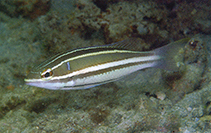
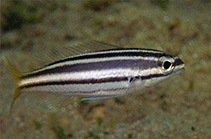
Dorsalspines (total): 10; Dorsalsoft rays (total): 9; Analspines: 3; Analsoft rays: 7. Head scales reaching forward to between level of posterior and anterior nostrils. Suborbital naked. Lower limb of preopercle with 2 or 3 scale rows. Pelvic fins moderately long, reaching to or almost to level of anus. Axillary scale present. Color: Upper body brown, white on ventral surface. This species is easily distinguished from P. trivittatus by the head scales extending forward to the nostrils, the absence of scales on the suborbital, and presence of a white bar on the upper margin of the opercle. Body shape (shape guide): fusiform / normal; Cross section: oval.
Solitary or in groups in shallow silty coral reef areas (Ref. 90102). Feeds on small fishes, crustaceans (shrimps, caprellid amphipods) and polychaete worms.
Life cycle and mating behavior Maturity | Reproduction | Spawning | Eggs | Fecundity | Larvae
Russell, B.C., 1990. FAO Species Catalogue. Vol. 12. Nemipterid fishes of the world. (Threadfin breams, whiptail breams, monocle breams, dwarf monocle breams, and coral breams). Family Nemipteridae. An annotated and illustrated catalogue of nemipterid species known to date. FAO Fish. Synop. 125(12):149p. Rome: FAO. (Ref. 3810)
IUCN Red List Status (Ref. 130435: Version 2025-2 (Global))
Preferred temperature (Ref. 123201): 28.4 - 29.2, mean 28.8 °C (based on 719 cells).
Phylogenetic diversity index (Ref. 82804): PD50 = 0.5001 [Uniqueness, from 0.5 = low to 2.0 = high].
Bayesian length-weight: a=0.01413 (0.00668 - 0.02988), b=2.97 (2.80 - 3.14), in cm total length, based on LWR estimates for this (Sub)family-body shape (Ref. 93245).
Trophic level (Ref. 69278): 3.6 ±0.55 se; based on food items.
Resilience (Ref. 120179): High, minimum population doubling time less than 15 months (Preliminary K or Fecundity.).
Fishing Vulnerability (Ref. 59153): Low vulnerability (10 of 100). 🛈