This website uses cookies to enhance your browsing experience and ensure the functionality of our site. For more detailed information about the types of cookies we use and how we protect your privacy, please visit our Privacy Information page.
×
Cookie Settings
This website uses different types of cookies to enhance your experience. Please select your preferences below:
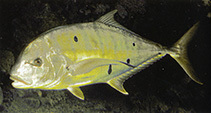
Gnathanodon speciosus, Golden trevally : fisheries, aquaculture, gamefish, aquarium
Indo-Pacific: from Kwazulu-Natal, South Africa, north to Mie Prefecture, Japan and east to southwestern coast of Baja California Sur, Mexico and Gulf of California to Ecuador (Ref. 9283).
Length at first maturity / Size / Weight / Age
Maturity: Lm32.5 range ? - ? cm Max length : 120 cm TL male/unsexed; (Ref. 11441); common length : 75.0 cm FL male/unsexed; (Ref. 9283); max. published weight: 15.0 kg (Ref. 30874)
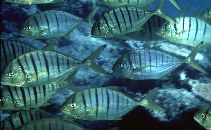
Adults occur in deep lagoon and seaward reefs where they feed by rooting for crustaceans and fossorial invertebrates in the sand but they also feed on small fishes (Ref. 9710, 90102). Small juveniles live among the tentacles of jellyfish (Ref. 9710). Adults form schools and are also noted for their behavior to closely swim around sharks and other large fishes, and also follow divers (Ref. 10361). Juveniles particularly display this piloting behavior to gain protection from likely predators (Ref. 9710, 90102). Marketed fresh and salted or dried (Ref. 9283). Juveniles are used in the aquarium trade. Minimum depth reported taken from Ref. 128797.
Smith-Vaniz, W.F., 1995. Carangidae. Jureles, pámpanos, cojinúas, zapateros, cocineros, casabes, macarelas, chicharros, jorobados, medregales, pez pilota. p. 940-986. In W. Fischer, F. Krupp, W. Schneider, C. Sommer, K.E. Carpenter and V. Niem (eds.) Guia FAO para Identification de Especies para lo Fines de la Pesca. Pacifico Centro-Oriental. 3 Vols. FAO, Rome. (Ref. 9283)
IUCN Red List Status (Ref. 130435: Version 2025-2 (Global))