
|
Ammodytes americanus DeKay, 1842 American sand lance |
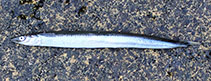
|
|
photo by
Sargent, P. |
| Family: | Ammodytidae (Sand lances) | |||
| Max. size: | 23.5 cm TL (male/unsexed) | |||
| Environment: | demersal; brackish; marine; depth range 0 - 73 m | |||
| Distribution: | Northwest Atlantic: southern Delaware north to Labrador. | |||
| Diagnosis: | Dorsal spines (total): 0-0; Dorsal soft rays (total): 52-61; Anal spines: 0-0; Anal soft rays: 26-33; Vertebrae: 62-70. Number of lateral plicae 106-126, with a mean of 117.4. Best separated from A. dubius by the number of plicae singly or in combination with the number of vertebrae. | |||
| Biology: | Found in shallow coastal waters as well as in protected bays and estuaries (Ref. 10198). Occurs in large schools and burrows in the sand at times to a depth of several inches. Feeds primarily on copepods (Ref. 27549). | |||
| IUCN Red List Status: | Not Evaluated (N.E.) Ref. (130435) | |||
| Threat to humans: | harmless | |||