
|
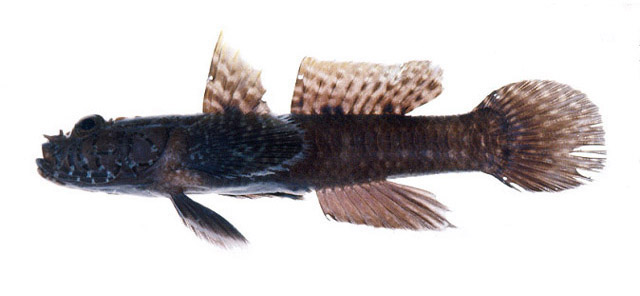
Callogobius snelliusi Koumans, 1953 |
|
|
photo by
Senou, H. |
| Family: | Gobiidae (Gobies), subfamily: Gobiinae | |||
| Max. size: | 3.3 cm SL (male/unsexed) | |||
| Environment: | reef-associated; marine; depth range 3 - 15 m | |||
| Distribution: | Western Pacific: Japan, Indonesia, and the east coast of northern Australia. | |||
| Diagnosis: | Dorsal spines (total): 6-7; Dorsal soft rays (total): 8-10; Anal spines: 1-1; Anal soft rays: 6-8. Characterized by dark brown color of head and body with scattered white flecks; dusky brown dorsal fins with pale bands or rows of dark brown spots and 1-2 relatively large blackish spots on basal portion; dusky brown caudal fin with rows of dark spots; brown pelvic and anal fins; brown pectoral fins with white spots; united pelvic fins with frenum; rounded caudal fin; longitudinal scale series 28-30; cycloid scales on head and anterior body, ctenoid posteriorly; cheek and opercle with cycloid scales; predosal scales 8-11, extending to rear margin of eyes; head with prominent papillae ridges; depth of body 4.0-5.6 in SL (Ref. 90102). | |||
| Biology: | Inhabits rocky shores and coral reefs in 3-15 m (Ref. 90102). | |||
| IUCN Red List Status: | Data deficient (DD); Date assessed: 19 March 2024 Ref. (130435) | |||
| Threat to humans: | harmless | |||