
|
Channa argus (Cantor, 1842) Snakehead |
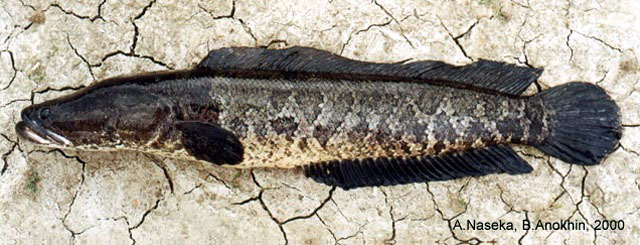
|
|
photo by
Naseka, A. / Anokhin, B. |
| Family: | Channidae (Snakeheads) | |||
| Max. size: | 100 cm TL (male/unsexed); max.weight: 8,000.0 g | |||
| Environment: | benthopelagic; freshwater, non-migratory | |||
| Distribution: | Asia: Amur southward to Xi Jiang and Hainan Island, China (Ref. 82587). Introduced elsewhere. Japan (Ref. 6094) and the USA (Ref. 51238) report adverse ecological impact after introduction. | |||
| Diagnosis: | Dorsal spines (total): 0-0; Dorsal soft rays (total): 49-54; Anal spines: 0-0; Anal soft rays: 32-38 | |||
| Biology: | Individuals can stay out of the water for 3 to 4 days at temperatures ranging from 10 to 15°C (Ref. 37350). They are typical ambush predators that lie waiting for prey on the bottom. They hunt mainly in the morning and in the evening, feeding primarily on fish (Ref. 12569). They mature at the age of 2 years and length of 30 cm. Spawning takes place in June and July (Ref. 56557). Eggs are pelagic. Utilized for human consumption. | |||
| IUCN Red List Status: | Least Concern (LC); Date assessed: 24 February 2020 Ref. (130435) | |||
| Threat to humans: | potential pest | |||