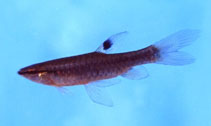
| Family: |
Lebiasinidae (Pencilfishes), subfamily: Pyrrhulininae |
| Max. size: |
5.64 cm SL (male/unsexed); 4.42 cm SL (female) |
| Environment: |
benthopelagic; freshwater; pH range: 5.8 - 7.5; dH range: 25 |
| Distribution: |
South Amercia: Rio Orinoco basin (Colombia and Venezuela); upper rio Negro (Brazil and Venezuela) and upper rio Putumayo drainage (Colombia, rio Amazonas basin). |
| Diagnosis: |
Dorsal soft rays (total): 8-8; Anal soft rays: 9-9; Vertebrae: 34-34. This species is distinguished from all its congeners by the following characters: middle caudal-fin rays dark (vs. hyaline or with a small dark patch at base of middle caudal-fin rays on callolepis); differs further from arnoldi by having the procurrent caudal-fin rays black (vs. hyaline); differs from compta by having 14±15 scales on the first longitudinal scale row (vs. 16±17); differs from nattereri by the absence of a black spot on the
posterior portion of each body scale (vs. presence); differs from callolepis by the absence of a series of conspicuous clear spot on each scale of the fourth longitudinal scale row (vs. presence); males differs from those of vilmae by the absence of discontinuous longitudinal series of dark scales on body (vs. continuous), and from females of vilmae by the absence of a small dark spot at the base of the upper caudal-fin lobe (vs. presence) (Ref. 137764). |
| Biology: |
Found in weedy river bays (Ref. 598). |
| IUCN Red List Status: |
Least Concern (LC); Date assessed: 11 September 2020 Ref. (130435)
|
| Threat to humans: |
harmless |
Source and more info: www.fishbase.org. For personal, classroom, and other internal use only. Not for publication.