
|
Cottus tallapoosae Neely, Williams & Mayden, 2007 |
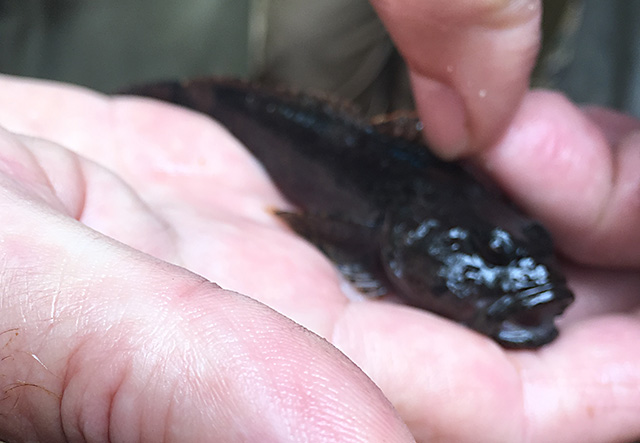
|
|
photo by
Drummond, J. |
| Family: | Cottidae (Sculpins) | |||
| Max. size: | 7.73 cm SL (male/unsexed) | |||
| Environment: | benthopelagic; freshwater | |||
| Distribution: | North America: endemic to the Tallapoosa River drainage above the Fall Line in the east-central Alabama and west-central Georgia, USA. | |||
| Diagnosis: | Dorsal spines (total): 6-8; Dorsal soft rays (total): 14-18; Anal soft rays: 10-14; Vertebrae: 29-32. Diagnosed from all congeners except Cottus chattahoochee by the combination of the following characters: modally eight infraorbital canal pores; five bones in the suborbital series; reduced palatine teeth; a flexible spine and four rays in the pelvic fin; preoperculomandibular canals not fused at anterior rami of mandibles, with two pores at tip of chin; pectoral rays simple; preopercular armature well-developed with two or three spines; chin not mottled; and dorsal fins separate. Differs from Cottus chattahoochee by having the following features: usually incomplete lateral line (vs. complete); dermal prickling reduced or absent, when present generally restricted to a few scattered prickles in area along anterior part of lateral line (vs. a robust postpectoral patch in addition to prickles along the anterior lateral line); and narrow to moderately wide saddles (vs. moderate or wide) (Ref. 72414). | |||
| Biology: | Inhabits clean gravel or rocky bottomed streams with moderate to swift current. Frequently found in streams 3-15 m wide and at depths of 0.5-0.7 m (Ref. 72414). Feeds on anything alive which fits into its mouth (Ref. 72414). | |||
| IUCN Red List Status: | Least Concern (LC); Date assessed: 11 November 2011 Ref. (130435) | |||
| Threat to humans: | harmless | |||