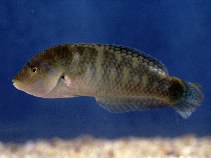
| Family: |
Labridae (Wrasses), subfamily: Julidinae |
| Max. size: |
14.6 cm TL (male/unsexed) |
| Environment: |
reef-associated; marine; depth range 3 - 10 m |
| Distribution: |
Indo-West Pacific: East Africa and Persian Gulf to East Indian region (excluding Papua New Guinea and Solomon Islands); north to China and Taiwan; south to Australia. |
| Diagnosis: |
Dorsal spines (total): 9-9; Dorsal soft rays (total): 12-12; Anal spines: 3-3; Anal soft rays: 11-12. This species is distinguished by the following characters: greatest body depth 2.9-3.6 in SL; pectoral-fin rays usually 14. Colour of male green on head and upper two-thirds of body, white on ventral part with inter-connected brown bars on side; lavander bands on head; between 6th and 7th dorsal spines, a diffuse dark spot; upper pectoral fin base with a small black spot; colour of female dark greenish-brown on upper half of body with several small, white spots along middle of the side (Ref. 90102). |
| Biology: |
Inhabit shallow weedy areas of rocky shorelines with little coral growth (Ref. 9710). Found in groups (Ref. 90102). |
| IUCN Red List Status: |
Least Concern (LC); Date assessed: 12 April 2008 Ref. (130435)
|
| Threat to humans: |
harmless |
Source and more info: www.fishbase.org. For personal, classroom, and other internal use only. Not for publication.