| Family: |
Blenniidae (Combtooth blennies), subfamily: Salariinae |
| Max. size: |
3.085 cm SL (male/unsexed); 2.69 cm SL (female) |
| Environment: |
reef-associated; marine; depth range 3 - 15 m |
| Distribution: |
Western Atlantic: Brazil (Trindade Island and Martin Vaz). |
| Diagnosis: |
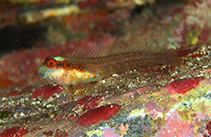
Dorsal spines (total): 12-12; Dorsal soft rays (total): 13-14; Anal spines: 2-2; Anal soft rays: 15-16; Vertebrae: 36-36. This species is distinguished from its congeners by the following set of characters: pelvic-fin rays I, 3, dorsal fin usually XII,13, anal fin II,15-16 (usually 16), no blackened stripes, nape green or white and presence of numerous tiny red spots along body, diminishing in size posteriorly (Ref. 94079). |
| Biology: |
Found either solitary or in small groups of up to 10 individuals; in small holes or associated with sea-urchins and sponges on the rocky reefs (Ref. 94079). Oviparous. Eggs are demersal and adhesive (Ref. 205), and are attached to the substrate via a filamentous, adhesive pad or pedestal (Ref. 94114). Larvae are planktonic, often found in shallow, coastal waters (Ref. 94114). |
| IUCN Red List Status: |
Endangered (EN); Date assessed: 05 March 2024 (B2ab(iii)) Ref. (130435)
|
| Threat to humans: |
harmless |
Source and more info: www.fishbase.org. For personal, classroom, and other internal use only. Not for publication.