
|
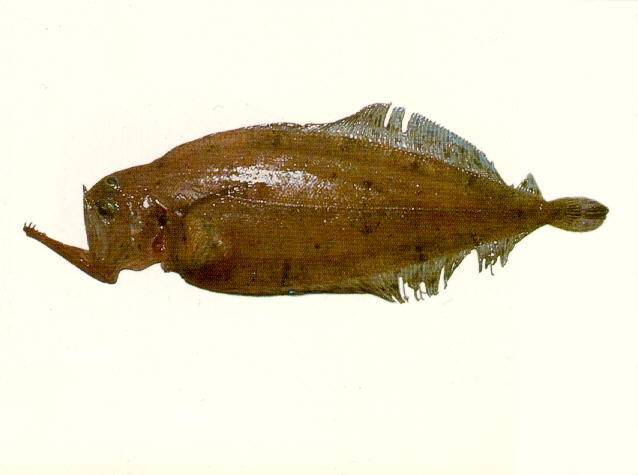
Kamoharaia megastoma (Kamohara, 1936) Wide-mouthed flounder |
|
|
photo by
CSIRO |
| Family: | Bothidae (Lefteye flounders) | |||
| Max. size: | 22.5 cm TL (male/unsexed) | |||
| Environment: | bathydemersal; marine | |||
| Distribution: | Western Pacific: southern Japan and Taiwan to the Indo-Australian Archipelago (including western Australia). | |||
| Diagnosis: | Dorsal spines (total): 0-0; Dorsal soft rays (total): 109-112; Anal spines: 0-0; Anal soft rays: 84-86. Mouth extremely large, maxillary strongly protruding beyond the tip of the snout anteriorly, and extending far beyond lower eye posteriorly. Upper jaw with 3 to 4 pairs of larger teeth anteriorly, and lower jaw with 3 pairs of curved strong canines anteriorly. Pectoral fin dark. | |||
| Biology: | Inhabits sand and mud bottoms at depths of about 800 m (Ref. 9824). Rarely caught with bottom trawls (Ref. 9824). | |||
| IUCN Red List Status: | Least Concern (LC); Date assessed: 12 November 2019 Ref. (130435) | |||
| Threat to humans: | harmless | |||