
|
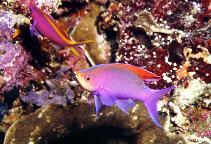
Mirolabrichthys tuka Herre & Montalban, 1927 Yellowstriped fairy basslet |
|
|
photo by
Patzner, R. |
| Family: | Anthiadidae (Fairy basslets or Streamer basses) | |||
| Max. size: | 12 cm TL (male/unsexed) | |||
| Environment: | reef-associated; marine; depth range 2 - 40 m | |||
| Distribution: | Indo-West Pacific: Mauritius to the Philippines and Bali (Indonesia) to the Solomon Islands, south to Rowley Shoals and the Great Barrier Reef; Palau in Micronesia. Reported from southern Japan (Ref. 9710). | |||
| Diagnosis: | Dorsal spines (total): 10-10; Dorsal soft rays (total): 15-17; Anal spines: 3-3; Anal soft rays: 7-8. Males of this species differ from males of P. pascalus by having a yellowish snout (Ref. 37816). Description: Characterized by male having uniformly purple color with posterior dorsal fin with large dark purple blotch; nuptial male with yellow jaws; female with yellow stripe along back connecting until yellow upper caudal fin; greatest depth of body 2.8-3.3 in SL; presence of fleshy protuberance at front of upper lip in male; deeply forked caudal fin with prolonged lobes in male (Ref. 90102). | |||
| Biology: | Found primarily on continental reefs (Ref. 9710). Form aggregations on outer reef slopes to depths over 30 m (Ref. 9710). Feeds on planktonic crustaceans and fish eggs (Ref. 9710). | |||
| IUCN Red List Status: | Least Concern (LC); Date assessed: 13 March 2015 Ref. (130435) | |||
| Threat to humans: | harmless | |||