
|
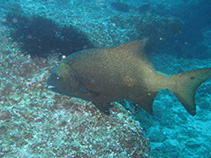
Oplegnathus robinsoni Regan, 1916 Natal knifejaw |
|
|
photo by
Alexandre, D. |
| Family: | Oplegnathidae (Knifejaws) | |||
| Max. size: | 60 cm TL (male/unsexed) | |||
| Environment: | reef-associated; marine; depth range 20 - 100 m | |||
| Distribution: | Western Indian Ocean: occurs only in Mozambique and Natal, South Africa. | |||
| Diagnosis: | Dorsal spines (total): 11-11; Dorsal soft rays (total): 20-24; Anal spines: 3-3; Anal soft rays: 14-17. Adults dark grey in color; juveniles yellow with black bars (very similar to young Diplodus cervinus hottentotus. | |||
| Biology: | Occur in coastal rocky and coral reefs to a depth of 100 m; juveniles pelagic in currents (Ref. 4332). Benthic omnivores. May live longer than 10 years. Spawning occurs throughout the year (Ref. 57746). Marketed fresh (Ref. 9660). | |||
| IUCN Red List Status: | Not Evaluated (N.E.) Ref. (130435) | |||
| Threat to humans: | harmless | |||