
|
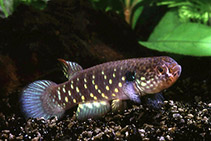
Pituna poranga Costa, 1989 |
|
|
photo by
Vermeulen, F. |
| Family: | Rivulidae (Rivulines), subfamily: Rivulinae | |||
| Max. size: | 3.26 cm SL (male/unsexed); 2.8 cm SL (female) | |||
| Environment: | benthopelagic; freshwater | |||
| Distribution: | South America: temporary swamps of the middle rio Araguaia basin in Brazil. | |||
| Diagnosis: | Dorsal soft rays (total): 8-10; Anal soft rays: 14-16; Vertebrae: 28-29. Can be distinguished from all its congeners by the following combination of characters: 25-29 scales in longitudinal series; pectoral fin with vertical rows of small dark gray spots or dark gray bars in males; frontal squamation F-patterned, anterior section of supraorbital series of neuromasts continuous; dark marks on flanks mainly longitudinally arranged in females; body depth 21.3-24.6% SL in males and 18.1-23.8% SL in females; caudal peduncle depth 15.5-17.1% SL in males and 14.7-15.7% SL in females; head depth 69.4-75.4% SL in males and 65.2-68.1% SL in females; and 4-5 bars or transverse rows of spots on pectoral fins in males (Ref. 57947). | |||
| Biology: | Inhabits temporary swamps, usually in open areas of savanna vegetation (Ref. 57947). | |||
| IUCN Red List Status: | Least Concern (LC); Date assessed: 07 November 2018 Ref. (130435) | |||
| Threat to humans: | harmless | |||