
|
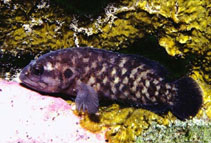
Pseudogramma axelrodi Allen & Robertson, 1995 |
|
|
photo by
Robertson, R. |
| Family: | Grammistidae (Soapfishes) | |||
| Max. size: | 6.1 cm SL (male/unsexed) | |||
| Environment: | reef-associated; marine; depth range 15 - 100 m | |||
| Distribution: | Eastern Pacific: Clipperton Islands. | |||
| Diagnosis: | Dorsal spines (total): 6-7; Dorsal soft rays (total): 20-22; Anal spines: 3-3; Anal soft rays: 17-18; Vertebrae: 26-26. Live specimens brown, including fins; body covered with numerous large tan blotches. Upper part of operculum with a prominent eye-sized ocellated dark brown spot; two dark brown lines radiating backward from lower half of eye across the cheek, and a vertical white bar below the eye. Lateral line scales + 4-23 when counting pored as well as the tubed scales. Longitudinal scale series 49-51. A short, broad-based, triangular, dermal flap dorsally on eye. A large pore in interorbital space on each side close to the edge of the orbit; a small median pore posterior in interorbital space. Tubular anterior nostril when laid back reach slightly more than half distance to posterior nostril. | |||
| Biology: | A cryptic species found in crevices and caves on the outer reef slope at 15-30 m; collected with rotenone (Ref. 81033). Minimum depth from Ref. 58018. | |||
| IUCN Red List Status: | Near Threatened (NT); Date assessed: 03 May 2008 Ref. (130435) | |||
| Threat to humans: | harmless | |||