
|
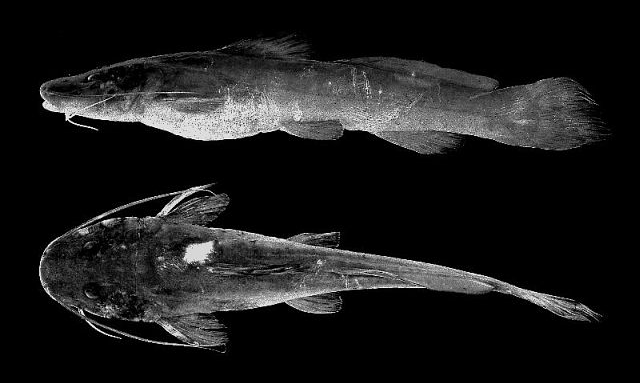
Rhamdia jequitinhonha Silfvergrip, 1996 |
|
|
photo by
Johansson, G.G. |
| Family: | Heptapteridae (Three-barbeled catfishes) | |||
| Max. size: | 16.1 cm SL (male/unsexed) | |||
| Environment: | benthopelagic; freshwater | |||
| Distribution: | South America: Jequitinhonha River basin, Brazil. | |||
| Diagnosis: | Dorsal spines (total): 1-1; Dorsal soft rays (total): 6-6; Anal spines: 0-0; Anal soft rays: 12-12; Vertebrae: 39-39. Rhamdia jequitinhonha is diagnosed from its congeners by a unique set of character states: pectoral fin spine with serrations on both sides; head sensory canals multiple; few caudal fin upper lobe procurrent rays (10); adipose fin 34.7% of SL or 141% of HL; free post-Weberian vertebrae, 39; maxillary barbels 39.2% of SL or 159% of HL; caudal fin lower lobe slightly the longer; color pattern uniform with faint lateral stripe, no apparent irregular blotches, or dark saddle-like marking across nape. | |||
| Biology: | ||||
| IUCN Red List Status: | Near Threatened (NT); Date assessed: 18 May 2022 (B1b(iii)) Ref. (130435) | |||
| Threat to humans: | harmless | |||