Microstomus kitt, Lemon sole : fisheries, gamefish, aquarium

You can sponsor this page

Microstomus kitt (Walbaum, 1792)

Lemon sole
Adicionar sua observação em Fish Watcher
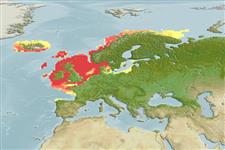
Native range | All suitable habitat | Point map | Year 2050
This map was computer-generated and has not yet been reviewed.
Microstomus kitt   AquaMaps   Data sources: GBIF OBIS
Carregue seu(sua) Fotos e vídeos
Fotos | vídeos | Imagem do Google
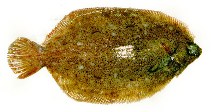
Image of Microstomus kitt (Lemon sole)
Microstomus kitt
Foto de Dolgov, A.


Denmark country information

Common names: Almindelig rødtunge, Rødtunge
Occurrence: native
Salinity: marine
Abundance: fairly common (chances are about 50%) | Ref: Winkler, H.M., K. Skora, R. Repecka, M. Ploks, A. Neelov, L. Urho, A. Gushin and H. Jespersen, 2000
Importance: minor commercial | Ref:
Aquaculture: | Ref:
Regulations: restricted | Ref:
Uses: no uses
Comments: Occurs in all the waters around Denmark except the Baltic Sea. Minimum size limit in TL: 26 cm in the North Sea and 28 cm elsewhere. For commercial fishing: 25 cm in the North Sea, Skagerrak and Kattegat (Ref. 10963). Also Ref. 9900, 173.
National Checklist:
Country Information: https://www.cia.gov/library/publications/resources/the-world-factbook/geos/da.html
National Fisheries Authority:
Occurrences: Occurrences Point map
Main Ref: Muus, B.J. and P. Dahlstrøm, 1989
National Database:

Common names from other countries

Classificação / Nomes Nomes comuns | Sinônimos | Catalog of Fishes(Gênero, Espécies) | ITIS | CoL | WoRMS | Cloffa

> Pleuronectiformes (Flatfishes) > Pleuronectidae (Righteye flounders) > Microstominae
Etymology: Microstomus: Greek, mikros = small + Greek, stoma = mouth (Ref. 45335).
More on author: Walbaum.

Environment: milieu / Zona climática / intervalo de profundidade / distribution range Ecologia

marinhas demersal; oceanódromo (Ref. 51243); intervalo de profundidade 10 - 200 m, usually 10 - 150 m (Ref. 35388). Temperate; 72°N - 43°N, 26°W - 45°E (Ref. 54592)

Distribuição Países | Áreas da FAO | Ecossistemas | Ocorrências | Mapa de pontos | Introduções | Faunafri

Northeast Atlantic: Bay of Biscay to the White Sea and off Iceland.

Comprimento de primeira maturação / Tamanho / Peso / Idade

Maturidade: Lm 29.3, range 20 - 30 cm
Max length : 65.0 cm TL macho/indeterminado; (Ref. 9988); peso máx. publicado: 3.0 kg (Ref. 6112); idade máx. registrada: 23 anos (Ref. 6112)

Descrição suscinta Chaves de identificação | Morfologia | Morfometria

Small head and mouth. Body is oval. Skin is marbled and smooth. Lateral line almost straight, slight curve above the pectoral fin (Ref. 35388).
Body shape (shape guide): short and / or deep.

Biologia     Glossário (p.ex. epibenthic)

Lives most often on stony bottoms. Feeds on a variety of small invertebrates, but polychaetes seem to dominate. Apparently they do not feed in wintertime (Ref. 9900). Marketed fresh and frozen; eaten steamed, fried, broiled, microwaved and baked (Ref. 9988).

Ciclo de vida ou comportamento de acasalamento Maturidade | Reprodução | Desova | Ovos | Fecundidade | Larvas

Spawning is mainly confined to depths of 55-91 m in the northwestern North Sea and commences at a minimum temperature of 6.5 °C in Scottish waters. Sex ratio is about 1:1, but females progressively predominate upon sexual maturity.

Referência principal Carregar suas referências | Referências | Coordenador : Amaoka, Kunio | Colaboradores

Vinnikov, K.A., R.C. Thomson and T.A. Munroe, 2018. Revised classification of the righteye flounders (Teleostei: Pleuronectidae) based on multilocus phylogeny with complete taxon sampling. Molecular phylogenetics and evolution, 125:147-162. (Ref. 122998)

Status na Lista Vermelha da UICN (Ref. 130435: Version 2025-1)

  Segura ou pouco preocupante (LC) ; Date assessed: 02 March 2021

CITES

Not Evaluated

CMS (Ref. 116361)

Not Evaluated

Ameaça para os humanos

  Harmless


Uso pelos humanos

Pescarias: espécies comerciais; peixe esportivo: sim; Aquário: Aquários públicos
FAO - pescarias: desembarques, perfil da espécie; Publication: search | FishSource | Sea Around Us

Mais informação

Ecologia Trófica
Food items (preys)
Composição da dieta
Consumo alimentar
Food rations
Predadores
Ecologia
Ecologia
Home ranges
Life cycle
Reprodução
Maturidade
Maturity/Gills rel.
Fecundidade
Desova
Spawning aggregations
Ovos
Desenvolvimento dos ovos
Larvas
Dinâmica larval
Distribuição
Países
Áreas da FAO
Ecossistemas
Ocorrências
Introduções
BRUVS - Videos
Anatomy
Área branquial
Brain
Otolith
Physiology
Body composition
Nutrients
Consumo de oxigênio
Tipo de natação
Velocidade de natação
Visual pigments
Fish sound
Diseases & Parasites
Toxicity (LC50s)
Genética
genoma
Genética
Heterozygosity
Hereditariedade
Human related
Aquaculture systems
Perfis para aquacultura
Estirpes
Ciguatera cases
Stamps, coins, misc.
Outreach
Colaboradores
Referências
Referências

Ferramentas

Relatórios especiais

Baixar XML

Fontes da internet

Estimates based on models

Preferred temperature (Ref. 123201): 7.1 - 12.5, mean 9.9 °C (based on 1310 cells).
Índice de diversidade filogenética (Ref. 82804):  PD50 = 0.5312   [Uniqueness, from 0.5 = low to 2.0 = high].
Bayesian length-weight: a=0.00741 (0.00591 - 0.00930), b=3.09 (3.02 - 3.16), in cm total length, based on LWR estimates for this species (Ref. 93245).
Nível Trófico (Ref. 69278):  3.2   ±0.33 se; based on food items.
Resiliência (Ref. 120179):  Baixo, tempo mínimo de duplicação da população 4,5 - 14 anos (K=0.08-0.42; tm=3-6; tmax=23; Fec=19,680).
Prior r = 0.71, 95% CL = 0.47 - 1.07, Based on 1 full stock assessment.
Fishing Vulnerability (Ref. 59153):  Moderate to high vulnerability (51 of 100). 🛈
Climate Vulnerability (Ref. 125649):  Low to moderate vulnerability (29 of 100). 🛈
Categoria de preço (Ref. 80766):   Very high.
Nutrients (Ref. 124155):  Calcium = 20.4 [11.3, 39.5] mg/100g; Iron = 0.237 [0.134, 0.434] mg/100g; Protein = 17 [15, 19] %; Omega3 = 0.301 [0.150, 0.610] g/100g; Selenium = 18.1 [9.7, 37.5] μg/100g; VitaminA = 7.6 [1.8, 30.7] μg/100g; Zinc = 0.377 [0.264, 0.576] mg/100g (wet weight);