Common names from other countries
>
Eupercaria/misc (Various families in series Eupercaria) >
Sciaenidae (Drums or croakers)
Etymology: Pseudotolithus: Greek, pseudes = false + greek, otos = ear + Greek, lithos = stone (Ref. 45335).
Lingkungan: lingkungan / zona iklim / kisaran kedalaman / jangkauan distribusi
Ekologi
laut; air tawar; payau dasar (demersal); kisaran kedalaman 0 - 100 m (Ref. 3593), usually 50 - 100 m (Ref. 26999). Tropical; 17°N - 6°S, 17°W - 14°E (Ref. 54743)
Eastern Atlantic: west coast of Africa, from Senegal to at least southern Angola (Ref. 3593, 57396, 81656).
Panjang pada saat jatuh tempo pertama / Ukuran / Berat / umur
Kematangan: Lm 19.1 range ? - ? cm
Max length : 62.5 cm TL jantan/; (Ref. 52841); common length : 30.0 cm TL jantan/; (Ref. 3593); Umur maksimum dilaporkan: 5 Tahun (Ref. 72458)
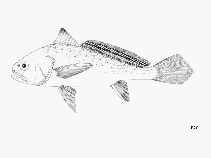
Duri punggung (Keseluruhan (total)) : 11; duri punggung lunak (Keseluruhan (total)) : 29 - 35; Duri dubur: 2; Sirip dubur lunak: 6 - 7. Diagnosis: medium-sized fish, fusiform/elongate and laterally compressed (Ref. 57396, 81656). Head and snout short (Ref. 57396). Eyes rather large (Ref. 57396, 81656), 3.6-4.6 times in HL, but this character is difficult to use for identification because of allometry (Ref. 81656). Mouth large and oblique (Ref. 57396, 81656), subterminal (Ref. 57396). Maxilla extending beyond posterior eye border (Ref. 81656). Teeth villiform, set in narrow bands in both jaws; 5 marginal pores on snout and 6 mental pores (Ref. 57396). Gill rakers long (Ref. 57396, 81656) and slender (Ref. 57396), longer than gill filaments at angle of first gill arch (Ref. 57396, 81656), 11-16/1/5-8 (total 19-25) on 1st gill arch (Ref. 81656). Lower part of 1st gill arch with 0-5 reduced additional gill rakers, upper part with 0-3 reduced additional ones; preopercular edge denticulate, with a few strong spines in the corner (Ref. 81656). Dorsal fin long, deeply notched (Ref. 57396), with 10 spines in 1st part and 1 spine and 29-35 soft rays in 2nd part (Ref. 81656). 2nd anal fin spine very strong, about as long as 1st soft ray (Ref. 57396, 81656) and comprised less than twice in head length (Ref. 57396). Pectoral fins long, 23.6-29.6% SL (Ref. 81656). Caudal fin more or less pointed (Ref. 57396, 81656) or rhomboidal (Ref. 81656). Scales ctenoid on body, cycloid on breast and head; lateral line extending to hind margin of caudal fin; swim bladder carrot-shaped, its front end with a pair of appendages subdividing into a group of short anterior branches and a bundle of 5-6 slender tubes extending backwards over half the length of swim bladder (Ref. 57396).
Coloration: general colour silver-grey with
a reddish sheen (Ref. 81656), back olivaceous brown (Ref. 57396) with series of dark dots, belly light, yellowish during reproduction period (Ref. 57396, 81656). Dorsal and caudal fins greyish (Ref. 81656). Spinous part of dorsal fin dark, soft part lighter, with 2-3 longitudinal series of dark dots; pelvics and anal fin yellowish (Ref. 57396, 81656).
Body shape (shape guide): fusiform / normal.
Found in coastal waters over mud bottom (Ref. 3593, 57396, 81656), very close to the shore (Ref. 57396). Also enters estuaries and coastal lagoons (Ref. 3593, 81656), where reproduction takes place (Ref. 57396). Moves farther offshore to about 100 m for spawning during rainy season from December to February; feeds on (juvenile) fish, shrimps (Ref. 28587, 81656) and other crustaceans (Ref. 81656).
Siklus hidup dan perilaku kawin
Kematangan | Reproduksi, perkembang biakan | Pemijahan | telur-telur | Fekunditas | Larva
Chao, L.N. and E. Trewavas, 1990. Sciaenidae. p. 813-826. In J.C. Quero, J.C. Hureau, C. Karrer, A. Post and L. Saldanha (eds.) Check-list of the fishes the eastern tropical Atlantic (CLOFETA). JNICT, Lisbon; SEI, Paris; and UNESCO, Paris. Vol. 2. (Ref. 3593)
Status IUCN Red List (Ref. 130435: Version 2025-2 (Global))
ancaman kepada manusia
Harmless
penggunaan manusia
Perikanan: komersial; Ikan buruan: ya
Alat, peralatan
laporan khas
muat turun XML
Sumber internet
Estimasi berdasarkan model
Suhu yang disukai (Acuan
123201): 16.3 - 20.9, mean 19.2 °C (based on 24 cells).
Indeks keanekaragaman filogenetik (Acuan
82804): PD
50 = 0.5156 [Uniqueness, from 0.5 = low to 2.0 = high].
Bayesian length-weight: a=0.00575 (0.00365 - 0.00908), b=3.09 (2.96 - 3.22), in cm total length, based on LWR estimates for this species & (Sub)family-body (Ref.
93245).
Tingkat Trofik (Acuan
69278): 4.1 ±0.70 se; based on food items.
Daya lenting (Acuan
120179): sedang, Waktu penggandaan populasi minimum 1.4 - 4.4 tahun (K=0.27-0.4; tmax=5;).
Prior r = 0.52, 95% CL = 0.34 - 0.78, Based on 3 data-limited stock assessments.
Kerentanan Penangkapan Ikan (Ref.
59153): Low to moderate vulnerability (32 of 100).
🛈
Kerentanan Iklim (Ref.
125649): High to very high vulnerability (74 of 100).
🛈
Nutrisi (Ref.
124155): Calcium = 127 [73, 238] mg/100g; Iron = 0.993 [0.527, 1.703] mg/100g; Protein = 19.4 [18.3, 20.4] %; Omega3 = 0.265 [0.140, 0.443] g/100g; Selenium = 56.6 [30.1, 109.3] μg/100g; VitaminA = 18.3 [6.6, 54.6] μg/100g; Zinc = 1.1 [0.8, 1.6] mg/100g (wet weight);