Microstomus kitt, Lemon sole : fisheries, gamefish, aquarium

You can sponsor this page

Microstomus kitt (Walbaum, 1792)

Lemon sole
Add your observation in Fish Watcher
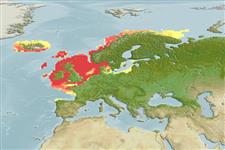
Native range | All suitable habitat | Point map | Year 2050
This map was computer-generated and has not yet been reviewed.
Microstomus kitt   AquaMaps   Data sources: GBIF OBIS
Upload your photos and videos
Φωτογραφίες | Videos | Google image
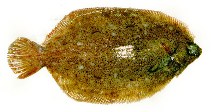
Image of Microstomus kitt (Lemon sole)
Microstomus kitt
Picture by Dolgov, A.


Ireland country information

Common names: [No common name]
Occurrence: native
Salinity: marine
Abundance: scarce (very unlikely) | Ref: Minchin, D., 1987
Importance: minor commercial | Ref: FAO, 1994
Aquaculture: | Ref:
Regulations: | Ref:
Uses: no uses
Comments:
National Checklist:
Country Information: https://www.cia.gov/library/publications/resources/the-world-factbook/geos/ei.html
National Fisheries Authority:
Occurrences: Occurrences Point map
Main Ref: Muus, B. and P. Dahlström, 1978
National Database:

Common names from other countries

Classification / Names Κοινά ονόματα | Συνώνυμα | Catalog of Fishes(Γένος, Είδη) | ITIS | CoL | WoRMS | Cloffa

> Pleuronectiformes (Flatfishes) > Pleuronectidae (Righteye flounders) > Microstominae
Etymology: Microstomus: Greek, mikros = small + Greek, stoma = mouth (Ref. 45335).
More on author: Walbaum.

Environment: milieu / climate zone / εύρος βάθους / distribution range Οικολογία

Θαλασσινό(ά) βενθικό(ς); ωκεανόδρομο(ς) (Ref. 51243); εύρος βάθους 10 - 200 m, usually 10 - 150 m (Ref. 35388). Temperate; 72°N - 43°N, 26°W - 45°E (Ref. 54592)

Κατανομή Χώρες | Περιοχές FAO | Οικοσυστήματα | Παρουσίες | Σημειακός χάρτης | Εισαγωγές | Faunafri

Northeast Atlantic: Bay of Biscay to the White Sea and off Iceland.

Length at first maturity / Μέγεθος / Βάρος / Age

Γεννητική Ωρίμανση: Lm 29.3, range 20 - 30 cm
Max length : 65.0 cm TL αρσενικό/απροσδιόριστο; (Ref. 9988); μεγ. δημοσιευμένο βάρος: 3.0 kg (Ref. 6112); μεγ. αναφερόμενη ηλικία: 23 έτη (Ref. 6112)

Short description Κλείδες προσδιορισμού | Μορφολογία | Μορφομετρία

Small head and mouth. Body is oval. Skin is marbled and smooth. Lateral line almost straight, slight curve above the pectoral fin (Ref. 35388).
Body shape (shape guide): short and / or deep.

Βιολογία     Γλωσσάρι (π.χ. epibenthic)

Lives most often on stony bottoms. Feeds on a variety of small invertebrates, but polychaetes seem to dominate. Apparently they do not feed in wintertime (Ref. 9900). Marketed fresh and frozen; eaten steamed, fried, broiled, microwaved and baked (Ref. 9988).

Life cycle and mating behavior Γεννητική Ωρίμανση | Αναπαραγωγή | Γεννοβολία | Αβγά | Γονιμότητα | Προνύμφες

Spawning is mainly confined to depths of 55-91 m in the northwestern North Sea and commences at a minimum temperature of 6.5 °C in Scottish waters. Sex ratio is about 1:1, but females progressively predominate upon sexual maturity.

Main reference Upload your references | Αναφορές | Συντονιστής : Amaoka, Kunio | Συνεργάτες

Vinnikov, K.A., R.C. Thomson and T.A. Munroe, 2018. Revised classification of the righteye flounders (Teleostei: Pleuronectidae) based on multilocus phylogeny with complete taxon sampling. Molecular phylogenetics and evolution, 125:147-162. (Ref. 122998)

IUCN Red List Status (Ref. 130435: Version 2025-1)

  Least Concern (LC) ; Date assessed: 02 March 2021

CITES

Not Evaluated

CMS (Ref. 116361)

Not Evaluated

Threat to humans

  Harmless


Human uses

αλιεία: Εμπορικό(ά); αλιεία αναψυχής: ναί; Ενυδρείο: Δημόσια ενυδρεία

Περισσότερες πληροφορίες

Τροφική Οικολογία
Food items (preys)
Σύσταση δίαιτας
Κατανάλωση τροφής
Food rations
Θηρευτές
Οικολογία
Οικολογία
Home ranges
Life cycle
Αναπαραγωγή
Γεννητική Ωρίμανση
Maturity/Gills rel.
Γονιμότητα
Γεννοβολία
Spawning aggregations
Αβγά
Egg development
Προνύμφες
Δυναμική προνυμφών
Κατανομή
Χώρες
Περιοχές FAO
Οικοσυστήματα
Παρουσίες
Εισαγωγές
BRUVS - Videos
Anatomy
Επιφάνεια βραγχίων
Brain
Otolith
Physiology
Body composition
Nutrients
Κατανάλωση οξυγόνου
Κολυμβητικός τύπος
Ταχύτητα κολύμβησης
Visual pigments
Fish sound
Diseases & Parasites
Toxicity (LC50s)
Γενετική
Genome
Γενετική
Heterozygosity
Κληρονομικότητα
Human related
Aquaculture systems
Προφίλ υδατοκαλλιεργειών
Στελέχοι
Ciguatera cases
Stamps, coins, misc.
Αναφορές
Αναφορές

Εργαλεία

Special reports

Download XML

Διαδικτυακές πηγές

Estimates based on models

Preferred temperature (Αναφ. 123201): 7.1 - 12.5, mean 9.9 °C (based on 1310 cells).
Phylogenetic diversity index (Αναφ. 82804):  PD50 = 0.5312   [Uniqueness, from 0.5 = low to 2.0 = high].
Bayesian length-weight: a=0.00741 (0.00591 - 0.00930), b=3.09 (3.02 - 3.16), in cm total length, based on LWR estimates for this species (Ref. 93245).
Τροφικό Επίπεδο (Αναφ. 69278):  3.2   ±0.33 se; based on food items.
Ελαστικότητα (Αναφ. 120179):  Χαμηλό, ελάχιστος χρόνος για διπλασιασμό πληθυσμού 4,5 - 14 έτη (K=0.08-0.42; tm=3-6; tmax=23; Fec=19,680).
Prior r = 0.71, 95% CL = 0.47 - 1.07, Based on 1 full stock assessment.
Fishing Vulnerability (Ref. 59153):  Moderate to high vulnerability (51 of 100). 🛈
Climate Vulnerability (Ref. 125649):  Low to moderate vulnerability (29 of 100). 🛈
Price category (Ref. 80766):   Very high.
Nutrients (Ref. 124155):  Calcium = 20.4 [11.3, 39.5] mg/100g; Iron = 0.237 [0.134, 0.434] mg/100g; Protein = 17 [15, 19] %; Omega3 = 0.301 [0.150, 0.610] g/100g; Selenium = 18.1 [9.7, 37.5] μg/100g; VitaminA = 7.6 [1.8, 30.7] μg/100g; Zinc = 0.377 [0.264, 0.576] mg/100g (wet weight);