Scomber japonicus, Chub mackerel : fisheries, aquaculture, gamefish, bait

You can sponsor this page

Scomber japonicus Houttuyn, 1782

Chub mackerel
Ajouter votre observation dans Fish Watcher
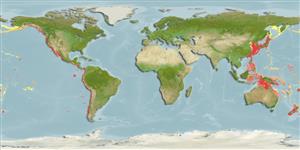
Native range | All suitable habitat | Point map | Year 2050
This map was computer-generated and has not yet been reviewed.
Scomber japonicus   AquaMaps   Data sources: GBIF OBIS
Envoyez vos Photos et vidéos
Images | Timbres, pièces de monnaie, divers | Images Google
Image of Scomber japonicus (Chub mackerel)
Scomber japonicus
Photo de Howe, C.


Liberia territory information

Common names: [No common name]
Occurrence: misidentification
Salinity: marine
Abundance: | Ref:
Importance: | Ref:
Aquaculture: | Ref:
Regulations: | Ref:
Uses: no uses
Comments: In Ref. 168.
National Checklist:
Territory Information: https://www.cia.gov/library/publications/resources/the-world-factbook/geos/li.html
National Fisheries Authority:
Occurrences: Occurrences Point map
Main Ref: Collette, B.B., 2003
National Database:

Common names from other countries

Classification / Noms Noms communs | Synonymes | Catalog of Fishes(Genre, Espèce) | ITIS | CoL | WoRMS | Cloffa

> Scombriformes (Mackerels) > Scombridae (Mackerels, tunas, bonitos) > Scombrinae
Etymology: Scomber: Greek, skombros = tunny or mackerel, 1623 (Ref. 45335)japonicus: Named after Japan, its type locality (Ref. 6885).

Environnement : milieu / zone climatique / profondeur / gamme de distribution Écologie

marin pelagic-neritic; océanodrome (Ref. 87829); profondeur 0 - 300 m (Ref. 168), usually 50 - 200 m (Ref. 35185). Subtropical; 10°C - 27°C (Ref. 35185); 60°N - 48°S, 116°E - 70°W

Distribution Territoires | Zones FAO | Écosystèmes | Occurrences | Carte par point | Introductions | Faunafri

Indo-Pacific: anti-tropical, absent from the Indian Ocean except for South Africa, KZN to Western Cape (58304).

Reports from Atlantic incl. Mediterranean are Scomber colias, and from Red Sea and northern Indian Ocean are Scomber australasicus (Ref. 27328).

Longueur à la première maturité / Taille / Poids / Âge

Maturité: Lm 26.1  range ? - ? cm
Max length : 64.0 cm TL mâle / non sexé; (Ref. 9015); common length : 30.0 cm FL mâle / non sexé; (Ref. 168); poids max. publié: 2.9 kg (Ref. 26550); âge max. reporté: 18 années (Ref. 35185)

Description synthétique Clés d'identification | Morphologie | Morphométrie

Épines dorsales (Total) : 9 - 11; Rayons mous dorsaux (Total) : 11 - 12; Épines anales: 1; Rayons mous anaux: 12 - 14; Vertèbres: 31. Interpelvic process small and single. No well developed corselet. Swim bladder present. First haemal spine posterior to first interneural process; 12 to 15 interneural bones under first dorsal fin. Anal fin spine conspicuous, clearly separated from anal rays but joined to them by a membrane. Back with narrow stripes which zigzag and undulate. Belly unmarked (Pacific population) or with wavy lines (Atlantic pop.) (Ref. 168). Caudal peduncle with 5 finlets on the upper and lower edge. Distance between dorsal fins shorter than or equal to the first dorsal fin base (Ref. 35388).
Body shape (shape guide): fusiform / normal; Cross section: oval.

Biologie     Glossaire (ex. epibenthic)

A coastal pelagic species, to a lesser extent epipelagic to mesopelagic over the continental slope (Ref. 168). Are considered as straddling stock in the eastern central Pacific (Ref. 87829). Schooling by size is well developed and initiates at approximately 3 cm (Ref. 168); may also form schools with Sarda chiliensis, Trachurus symmetricus and Sardinops sagax (Ref. 9340). Adults stay near the bottom during the day; go up to the open water at night, (Ref. 5377) where they feed on copepods and other crustaceans, fishes and squids (Ref. 168). They spawn in batches (Ref. 51846). Eggs and larvae are pelagic (Ref. 6769). In Asian waters, they move to deeper water and remain inactive during the winter season (Ref. 4576). Commercially cultured in Japan. Marketed fresh, frozen, smoked, salted and occasionally canned (Ref. 9684). Eaten fried, broiled and baked (Ref. 9988). Used in Chinese medicine (Ref. 12166).

Cycle de vie et comportement reproducteur Maturité | Reproduction | Frai | Œufs | Fécondité | Larves

Spawning most often occurs at water temperatures of 15° to 20°C. Spawn in several batches with 250 to 300 eggs per g of fish with the total number of eggs per female ranging from 100,000 to 400,000.

Référence principale Téléchargez vos références | Références | Coordinateur : Collette, Bruce B. | Collaborateurs

Collette, B.B. and C.E. Nauen, 1983. FAO Species Catalogue. Vol. 2. Scombrids of the world. An annotated and illustrated catalogue of tunas, mackerels, bonitos and related species known to date. Rome: FAO. FAO Fish. Synop. 125(2):137 p. (Ref. 168)

Statut dans la liste rouge de l'IUCN (Ref. 130435: Version 2025-2 (Global))

  Préoccupation mineure (LC) ; Date assessed: 01 June 2022

CITES

Not Evaluated

CMS (Ref. 116361)

Not Evaluated

Menace pour l'homme

  Harmless


Utilisations par l'homme

Pêcheries: hautement commercial; Aquaculture: commercial; pêche sportive: oui; appât: usually
FAO - pêcheries: débarquements, Résumé espèce; Publication: search | FIRMS - Stock assessments | FishSource | Sea Around Us

Plus d'informations

Anatomie
Surface branchiale
Cerveau
Otolithe
Physiologie
Composition corporelle
Nutriments
Consommation d'oxygène
Type de natation
Vitesse de nage
Pigments visuels
Son de poisson
Maladies et parasites
Toxicité (CL50)
Génétique
génôme
Génétique
Hétérozygotie
Héritabilité
Liées à l'homme
Systèmes d'aquaculture
Profils d'aquaculture
Souches
Cas de ciguatera
Timbres, pièces de monnaie, divers
Sensibilisation
Collaborateurs
Références
Références

Outils

Articles particuliers

Télécharger en XML

Sources Internet

Estimations basées sur des modèles

Température préférée (Réf. 123201): 9.3 - 27.7, mean 20.7 °C (based on 1526 cells).
Indice de diversité phylogénétique (Réf. 82804):  PD50 = 0.5625   [Uniqueness, from 0.5 = low to 2.0 = high].
Bayesian length-weight: a=0.00741 (0.00663 - 0.00828), b=3.05 (3.02 - 3.08), in cm total length, based on LWR estimates for this species (Ref. 93245).
Niveau trophique (Réf. 69278):  3.4   ±0.1 se; based on diet studies.
Generation time: 3.6 (3.1 - 5.0) years. Estimated as median ln(3)/K based on 24 growth studies.
Résilience (Réf. 120179):  Milieu, temps minimum de doublement de population : 1,4 à 4,4 années (K=0.12-0.22; tm=2-3; tmax=18).
Prior r = 0.35, 95% CL = 0.23 - 0.53, Based on 1 full stock assessment.
Vulnérabilité de la pêche (Ref. 59153):  Low to moderate vulnerability (31 of 100). 🛈
Vulnérabilité climatique (Ref. 125649):  Low vulnerability (24 of 100). 🛈
Catégorie de prix (Ref. 80766):   High.
Nutriments (Ref. 124155):  Calcium = 48.8 [16.2, 118.3] mg/100g; Iron = 2.18 [0.83, 5.26] mg/100g; Protein = 20.9 [19.8, 21.8] %; Omega3 = 0.358 [0.247, 0.525] g/100g; Selenium = 98.1 [37.9, 229.9] μg/100g; VitaminA = 13.7 [3.5, 60.5] μg/100g; Zinc = 0.846 [0.514, 1.358] mg/100g (wet weight); based on nutrient studies.