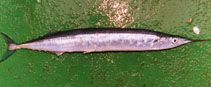
Scomberesox saurus, Atlantic saury : fisheries, bait

You can sponsor this page

Scomberesox saurus (Walbaum, 1792)

Atlantic saury
Добавить Ваши наблюдения в Fish Watcher
Native range | All suitable habitat | Point map | Year 2050
This map was computer-generated and has not yet been reviewed.
Scomberesox saurus   AquaMaps   Data sources: GBIF OBIS
Загрузить свой Фото и Видео
изображения | Изображение на Google
Image of Scomberesox saurus (Atlantic saury)
Scomberesox saurus
Изображение сделано Reyes, P.


Spain country information

Common names: Alcrique, Botakar, Botakor
Occurrence: native
Salinity: marine
Abundance: | Ref:
Importance: commercial | Ref:
Aquaculture: | Ref:
Regulations: | Ref:
Uses: no uses
Comments: Found in Galicia (Ref. 86578). Also Ref. 9987.
National Checklist:
Country Information: https://www.cia.gov/library/publications/resources/the-world-factbook/geos/sp.html
National Fisheries Authority:
Occurrences: Occurrences Point map
Main Ref: Muus, B. and P. Dahlström, 1978
National Database: ICTIMED

Common names from other countries

Классификация / Names народные названия | синонимы | Catalog of Fishes(род, виды) | ITIS | CoL | WoRMS | Cloffa

> Beloniformes (Needle fishes) > Scomberesocidae (Sauries)
Etymology: Scomberesox: Latin, scomber = mackerel + Esox, the old name for "pike" (Ref. 45335).
More on author: Walbaum.

Environment: milieu / climate zone / пределы глубины / distribution range экология

морской pelagic-oceanic; мигрирует в океане (Ref. 51243); пределы глубины 0 - 30 m (Ref. 6531). Subtropical; 66°N - 22°S, 98°W - 36°E

распространение страны | регионы FAO | Ecosystems | места находок | карта точек | интродукции | Faunafri

Arctic (Ref. 43202). North Atlantic. Eastern Atlantic: Iceland, Norway and Denmark (rarely), along British Isles into Baltic Sea and throughout the Mediterranean, Adriatic and Aegean seas to Morocco. Western Atlantic: Gulf of St. Lawrence, Canada to North Carolina, USA and Bermuda (Ref. 7251). Highly migratory species.

Length at first maturity / Size / Вес / Возраст

половая зрелость: Lm 26.5, range 25 - ? cm
Max length : 50.0 cm TL самец/пол неопределен; (Ref. 7251); common length : 32.0 cm TL самец/пол неопределен; (Ref. 3397)

биология     глоссарий (например epibenthic)

Oceanic, schooling and gregarious. Occasionally shoals close to shore in large numbers (Ref. 9987). Feeds on zooplankton and fish larvae (Ref. 9987); food also includes fish eggs and small fishes (Ref. 5951). Preyed upon by fish, including tunas, marlin bluefish and cod (Ref. 9987); also pollock, dolphins and porpoises (Ref. 5951). It is an under-exploited fish in many parts of its range and suitable for canning and other inexpensive uses (Ref. 9987). Often leap of the water when chased by enemies (Ref. 35388).

Life cycle and mating behavior половая зрелость | размножение | нерест | икра | Fecundity | личинки

Distinct pairing (Ref. 205). Presence of asynchronous oocyte development in the ovaries (Ref. 109439).

Основная ссылка Upload your references | ссылки | координатор | соавторы

Wisner, R.L., 1990. Scomberesocidae. p. 598-603. In J.C. Quero, J.C. Hureau, C. Karrer, A. Post and L. Saldanha (eds.) Check-list of the fishes of the eastern tropical Atlantic (CLOFETA). JNICT, Lisbon; SEI, Paris; and UNESCO, Paris. Vol. 2. (Ref. 6531)

Статус Красного Списка МСОП (Ref. 130435: Version 2025-1)

  Не вызывающий беспокойства (LC) ; Date assessed: 09 July 2012

CITES

Not Evaluated

CMS (Ref. 116361)

Not Evaluated

Угроза для людей

  Harmless


Использование человеком

рыболовство: не имеет хозяйственного значения; наживка: occasionally
FAO - рыболовство: landings; Publication: search | FishSource | Sea Around Us

дополнительная информация

Trophic ecology
Food items (preys)
состав пищи
потребление пищи
Food rations
хищники
экология
экология
Home ranges
Population dynamics
Growth parameters
Max. ages / sizes
Length-weight rel.
Length-length rel.
Размерный состав
Mass conversion
пополнение
численность
Life cycle
размножение
половая зрелость
Maturity/Gills rel.
Fecundity
нерест
Spawning aggregations
икра
Развитие икры
личинки
динамика численности личинок
распространение
страны
регионы FAO
Ecosystems
места находок
интродукции
BRUVS - Videos
Anatomy
жаберная область
Brain
Otolith
Physiology
Body composition
Nutrients
Oxygen consumption
Swimming type
Swimming speed
Visual pigments
Fish sound
Diseases & Parasites
Toxicity (LC50s)
генетика
Геном
генетика
Heterozygosity
наследуемость
Human related
Aquaculture systems
особенности рыбоводства
степень растяжения
Ciguatera cases
Stamps, coins, misc.
Outreach
соавторы
ссылки
ссылки

инструменты

Специальные отчеты

Скачать в формате XML

ресурсы в Интернет

Estimates based on models

Preferred temperature (ссылка 123201): 6.5 - 22, mean 14.4 °C (based on 7800 cells).
Phylogenetic diversity index (ссылка 82804):  PD50 = 0.6562   [Uniqueness, from 0.5 = low to 2.0 = high].
Bayesian length-weight: a=0.00214 (0.00102 - 0.00448), b=3.10 (2.91 - 3.29), in cm total length, based on LWR estimates for this species & (Sub)family-body (Ref. 93245).
Trophic level (ссылка 69278):  3.9   ±0.0 se; based on diet studies.
Generation time: 1.5 ( na - na) years. Estimated as median ln(3)/K based on 1 growth studies.
устойчивость к внешним воздействиям (ссылка 120179):  средний (среднего размера), минимальное время удвоения популяции 1.4-4.4 года (Assusming tm=2-4).
Fishing Vulnerability (Ref. 59153):  Low vulnerability (24 of 100). 🛈
Climate Vulnerability (Ref. 125649):  Low to moderate vulnerability (29 of 100). 🛈
Категория цены (Ref. 80766):   Low.
Nutrients (Ref. 124155):  Calcium = 173 [62, 370] mg/100g; Iron = 1.55 [0.80, 3.76] mg/100g; Protein = 17.9 [15.9, 19.9] %; Omega3 = 0.332 [0.154, 0.936] g/100g; Selenium = 22.7 [10.7, 47.6] μg/100g; VitaminA = 16.3 [5.3, 58.8] μg/100g; Zinc = 0.71 [0.48, 1.07] mg/100g (wet weight);