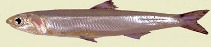
Engraulis encrasicolus, European anchovy : fisheries, bait

You can sponsor this page

Engraulis encrasicolus (Linnaeus, 1758)

European anchovy
Aggiungete la vostra osservazione in Fish Watcher
Native range | All suitable habitat | Point map | Year 2050
This map was computer-generated and has not yet been reviewed.
Engraulis encrasicolus   AquaMaps   Data sources: GBIF OBIS
Carica il tuo foto e Video
Immagini | Francobolli, monete, materiale vario. | Google image
Image of Engraulis encrasicolus (European anchovy)
Engraulis encrasicolus
Immagine di Dammous, S.

Common names from other countries

Classificazione / Nomi Nomi Comuni | Sinonimi | Catalog of Fishes(Genere, Specie) | ITIS | CoL | WoRMS | Cloffa

> Clupeiformes (Herrings) > Engraulidae (Anchovies) > Engraulinae
Etymology: Engraulis: Greek, eggraulis, -eos = anchovy (Ref. 45335).
More on author: Linnaeus.

Ambiente: milieu / zona climatica / distribuzione batimetrica / gamma di distribuzione Ecologia

marino; salmastro pelagic-neritic; oceanodromo (Ref. 51243); distribuzione batimetrica 0 - 400 m (Ref. 2683). Subtropical; 62°N - 37°S, 18°W - 42°E (Ref. 54230)

Distribuzione Territories | Aree FAO | Ecosistemi | Presenze | Mappa dei ritrovamenti | Introduzioni | Faunafri

Eastern Atlantic: Bergen, Norway to East London, South Africa (perhaps reaching Durban) (Ref. 10000). Also all of Mediterranean, Black and Azov seas, with stray individuals in Suez Canal and Gulf of Suez; also recorded from St. Helena (Ref. 189). Reported from Estonia (Ref. 33247).

Lunghezza alla prima maturità / Dimensione / Peso / Età

Maturità: Lm 10.1, range 9 - 14 cm
Max length : 20.0 cm SL maschio/sesso non determinato; (Ref. 189); common length : 13.5 cm SL maschio/sesso non determinato; (Ref. 189); peso massimo pubblicato: 0.00 g; Età massima riportata: 5 anni (Ref. 92145)

Breve descrizione Chiavi di identificazione | Morfologia | Morfometria

Spine dorsali (totale) : 0; Raggi dorsali molli (totale) : 16 - 18; Spine anali: 0; Raggi anali molli: 13 - 15; Vertebre: 46 - 47. Snout pointed; maxilla short, tip blunt, reaching almost to front border of pre-operculum, not projecting beyond tip of second supra-maxilla; tip of lower jaw reaching almost to below nostril. Gill rakers present on hind face of third epibranchial. Pseudobranch longer than eye, reaching onto inner face of operculum. A silver stripe along flank, disappearing with age.
Body shape (shape guide): elongated; Cross section: oval.

Biologia     Glossario (es. epibenthic)

Mainly oceanic, marine species, forming large schools (see Ref. 126017:598). Tolerates salinities of 5-41 ppt and in some areas, enters lagoons, estuaries and lakes, especially during spawning. Tends to move further north and into surface waters in summer, retreating and descending in winter. Feeds on planktonic organisms. Spawns from April to November with peaks usually in the warmest months. Eggs are ellipsoidal to oval, floating in the upper 50 m and hatching in 24-65 hours. Marketed fresh, dried, smoked, canned and frozen; made into fish meal (Ref. 9987).

Ciclo vitale e comportamento di accoppiamento Maturità | Riproduzione | Deposizione | Uova | Fecondità | Larve

Pelagic spawners. Gametogenesis is continuous, multiple spawning. Spawning peaks are usually in the warmer months which makes this species a spring-summer spawner. The limits of the spawning season is dependent on temperature and is therefore more restricted in northern areas. Sex ratio: 45% female (Ref. 5580).

Riferimento principale Caricare le referenze | Bibliografia | Coordinatore | Collaboratori

Whitehead, P.J.P., G.J. Nelson and T. Wongratana, 1988. FAO Species Catalogue. Vol. 7. Clupeoid fishes of the world (Suborder Clupeoidei). An annotated and illustrated catalogue of the herrings, sardines, pilchards, sprats, shads, anchovies and wolf-herrings. FAO Fish. Synop. 125(7/2):305-579. Rome: FAO. (Ref. 189)

Stato della Lista Rossa IUCN (Ref. 130435: Version 2025-2 (Global))

  Least Concern (LC) ; Date assessed: 23 May 2013

CITES

Not Evaluated

CMS (Ref. 116361)

Not Evaluated

Minaccia per l'uomo

  Harmless


Usi umani

Pesca: elevato interesse commerciale; esca: usually
FAO - pesca: sbarchi, profilo della specie; Publication: search | FIRMS - Stock assessments | FishSource | Sea Around Us

Informazioni ulteriori

Ciclo di vita
Riproduzione
Maturità
Maturità/Gli occhielli sono relativi.
Fecondità
Deposizione
Aggregazioni riproduttive
Uova
Sviluppo delle uova
Larve
Dinamica popolazioni larvali
Distribuzione
Territories
Aree FAO
Ecosistemi
Presenze
Introduzioni
BRUVS - Video
Anatomia
Area branchiale
Cervello
Otolite
Fisiologia
Composizione corporea
Nutrienti
Consumo di ossigeno
Tipo di nuoto
Velocità di nuoto
Pigmenti visivi
Suono del pesce
Malattie e parassiti
Tossicità (LC50)
Genetica
Genome
Genetica
Eterozigosi
Ereditarietà
Legato all'uomo
Sistemi di acquacoltura
Profili di acquacoltura
Varietà
Casi di Ciguatera
Francobolli, monete, materiale vario.
Raggiungimento
Collaboratori
Bibliografia
Bibliografia

Strumenti

Rapporti speciali

Scarica XML

Fonti Internet

Stime basate su modelli

Temperatura preferita (Fonte Biblio. 123201): 7.1 - 18, mean 10.8 °C (based on 667 cells).
Indice di diversità filogenetica (Fonte Biblio. 82804):  PD50 = 0.5020   [Uniqueness, from 0.5 = low to 2.0 = high].
Bayesian length-weight: a=0.00457 (0.00414 - 0.00505), b=3.10 (3.07 - 3.13), in cm total length, based on LWR estimates for this species (Ref. 93245).
Livello trofico (Fonte Biblio. 69278):  3.1   ±0.36 se; based on food items.
Generation time: 2.2 (1.8 - 2.8) years. Estimated as median ln(3)/K based on 50 growth studies.
Resilienza (Fonte Biblio. 120179):  Medio, tempo minimo di raddoppiamento della popolazione 1.4 - 4.4 anni (K=0.3-1.73; tmax=6; Fec =13,000-503,000).
Prior r = 0.59, 95% CL = 0.39 - 0.89, Based on 21 full stock assessments.
Vulnerabilità della pesca (Ref. 59153):  Low vulnerability (18 of 100). 🛈
Vulnerabilità climatica (Ref. 125649):  Low vulnerability (9 of 100). 🛈
Categoria di prezzo (Ref. 80766):   Medium.
Nutrienti (Ref. 124155):  Calcium = 170 [78, 369] mg/100g; Iron = 1.21 [0.63, 2.85] mg/100g; Protein = 18.7 [17.6, 20.0] %; Omega3 = 0.976 [0.611, 1.574] g/100g; Selenium = 19.1 [9.3, 36.9] μg/100g; VitaminA = 15.5 [4.4, 51.5] μg/100g; Zinc = 1.24 [0.79, 1.84] mg/100g (wet weight); based on nutrient studies.