



Add your observation in Fish Watcher
| Native range | All suitable habitat | Point map | Year 2050 |

|
| This map was computer-generated and has not yet been reviewed. |
| Chimaera monstrosa AquaMaps Data sources: GBIF OBIS |
Upload your photos and videos
Pictures | Videos | Google image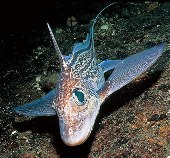 Chimaera monstrosa
Picture by Svensen, E.
Pictures | Videos | Google image
Picture by Svensen, E.
Classification / Names Common names | Synonyms | Catalog of Fishes(genus, species) | ITIS | CoL | WoRMS | Cloffa
Holocephali (chimaeras) > Chimaeriformes (Chimaeras) > Chimaeridae (Shortnose chimaeras or ratfishes)
Etymology: Chimaera: Named for the mythological creature composed of parts of multiple animals, referring to their odd mix of characteristics (See ETYFish); monstrosa: Latin for strange or grotesque, referring to its strange appearance, as if composed of parts of multiple animals (See ETYFish).
More on author: Linnaeus.
Etymology: Chimaera: Named for the mythological creature composed of parts of multiple animals, referring to their odd mix of characteristics (See ETYFish); monstrosa: Latin for strange or grotesque, referring to its strange appearance, as if composed of parts of multiple animals (See ETYFish).
More on author: Linnaeus.
Environment: milieu / climate zone / depth range / distribution range Ecology
Marine; bathydemersal; oceanodromous (Ref. 51243); depth range 40 - 1400 m (Ref. 104125), usually 300 - 500 m (Ref. 4443). Deep-water; 75°N - 27°N, 32°W - 35°E
Distribution Territories | FAO areas | Ecosystems | Occurrences | Point map | Introductions | Faunafri
Northeast Atlantic (widespread), including the Mid-Atlantic Ridge and the Mediterranean Sea.
Length at first maturity / Size / Weight / Age
Maturity: Lm 45.9 range ? - ? cm
Max length : 150 cm TL male/unsexed; (Ref. 35388); max. published weight: 2.5 kg (Ref. 4645)
Max length : 150 cm TL male/unsexed; (Ref. 35388); max. published weight: 2.5 kg (Ref. 4645)
Short description Identification keys | Morphology | Morphometrics
Body shape (shape guide): elongated.
Bathydemersal to benthopelagic generally between 300 and 500 m depth. Found in the upper continental slope. Usually found in deeper waters in southern latitudes, while making a summer inshore migration up to 40-100 m in the northern areas. Sluggish, usually occurring in small groups. Feeds mainly on bottom-living invertebrates. The single dorsal spine is sharp and pointed, and although only mildly venomous can inflict a painful wound. Oviparous. Males have a clasper on the forehead that is probably used to hold on to the female during copulation. Egg capsules are about 17 cm long; young look alike adults and hatch when 10 cm long. Common by-catch when trawling for shrimps in the North Sea or Skaggerak.
Life cycle and mating behavior Maturity | Reproduction | Spawning | Eggs | Fecundity | Larvae
Oviparous; egg-capsules slender, club-shaped with narrow lateral membranes and a horny filament at the long pointed end, 17 cm long and 3 cm wide; deposited mainly in spring and summer. The embryos developing in about 9-12 months and hatch at 10 cm length.
Main reference
Upload your references | References | Coordinator | Collaborators
Krefft, G., 1990. Chimaeridae. p. 111-113. In J.C. Quero, J.C. Hureau, C. Karrer, A. Post and L. Saldanha (eds.) Check-list of the fishes of the eastern tropical Atlantic (CLOFETA). JNICT, Lisbon; SEI, Paris; and UNESCO, Paris. Vol. 1. (Ref. 4443)
IUCN Red List Status (Ref. 130435: Version 2025-2 (Global))
Vulnerable (VU) (A2bd); Date assessed: 02 September 2019
CITES
Not Evaluated
Threat to humans
Traumatogenic (Ref. 4690)
Human uses
Fisheries: minor commercial
FAO - Fisheries: landings search; Publication: search | FIRMS - Stock assessments | FishSource | Sea Around Us
More information
Population dynamics
Growth parameters
Max. ages / sizes
Length-weight rel.
Length-length rel.
Length-frequencies
Mass conversion
Recruitment
Abundance
Growth parameters
Max. ages / sizes
Length-weight rel.
Length-length rel.
Length-frequencies
Mass conversion
Recruitment
Abundance
Life cycle
Reproduction
Maturity
Maturity/Gills rel.
Fecundity
Spawning
Spawning aggregations
Eggs
Egg development
Larvae
Larval dynamics
Reproduction
Maturity
Maturity/Gills rel.
Fecundity
Spawning
Spawning aggregations
Eggs
Egg development
Larvae
Larval dynamics
Physiology
Body composition
Nutrients
Oxygen consumption
Swimming type
Swimming speed
Visual pigments
Fish sound
Diseases & Parasites
Toxicity (LC50s)
Body composition
Nutrients
Oxygen consumption
Swimming type
Swimming speed
Visual pigments
Fish sound
Diseases & Parasites
Toxicity (LC50s)
Human related
Aquaculture systems
Aquaculture profiles
Strains
Ciguatera cases
Stamps, coins, misc.
Aquaculture systems
Aquaculture profiles
Strains
Ciguatera cases
Stamps, coins, misc.
Tools
Bio-Quiz | E-book | Field guide | Length-frequency wizard | Life-history tool | Point map |
Catch-MSY |
Special reports
Download XML
Internet sources
AFORO (otoliths) | Aquatic Commons | BHL | Cloffa | Websites from users | Check FishWatcher | CISTI | Catalog of Fishes: genus, species | DiscoverLife | ECOTOX | FAO - Fisheries: landings search; Publication: search | Faunafri | Fishipedia | Fishtrace | GloBI | Google Books | Google Scholar | Google | IGFA World Record | National databases | OneZoom | Open Tree of Life | Otolith Atlas of Taiwan Fishes | PubMed | Reef Life Survey | Socotra Atlas | TreeBase | Tree of Life | Wikipedia: Go, Search | | Zoobank | Zoological Record
Estimates based on models
|
Phylogenetic diversity index (Ref. 82804) |
PD50 = 0.5000 [Uniqueness, from 0.5 = low to 2.0 = high]. |
| Bayesian length-weight | a=0.00257 (0.00156 - 0.00424), b=3.01 (2.87 - 3.15), in cm total length, based on LWR estimates for this species & (Sub)family-body (Ref. 93245). |
|
Trophic level (Ref. 69278) |
3.5 ±0.0 se; based on diet studies. |
| Generation time | 16.4 ( na - na) years. Estimated as median ln(3)/K based on 2 growth studies. |
|
Resilience (Ref. 120179) |
Low, minimum population doubling time 4.5 - 14 years (Assuming Fec <100;). |
|
Fishing Vulnerability (Ref. 59153) |
High to very high vulnerability (68 of 100). 🛈 |
|
Climate Vulnerability (Ref. 125649) |
Moderate vulnerability (38 of 100). 🛈 |
|
Price category (Ref. 80766) |
Low. |
|
Nutrients (Ref. 124155) |
Calcium = 7.33 [2.04, 25.54] mg/100g; Iron = 0.33 [0.11, 0.85] mg/100g; Protein = 14.7 [9.9, 18.5] %; Omega3 = 0.239 [0.093, 0.622] g/100g; Selenium = 22 [6, 73] μg/100g; VitaminA = 5.79 [1.22, 27.56] μg/100g; Zinc = 0.326 [0.169, 0.636] mg/100g (wet weight); |