



Upload your photos and videos
Pictures | Google image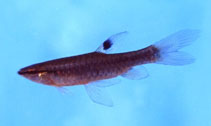 Copella eigenmanni
Picture by Landines, M.
Pictures | Google image
Picture by Landines, M.
Classification / Names Common names | Synonyms | Catalog of Fishes(genus, species) | ITIS | CoL | WoRMS | Cloffa
Teleostei (teleosts) > Characiformes (Characins) > Lebiasinidae (Pencilfishes) > Pyrrhulininae
Eponymy: Edward Drinker Cope (1840–1897) was an American palaeontologist, anatomist, herpetologist and ichthyologist. [...] Professor Dr Carl Henry Eigenmann (1863–1927) was a German-born American ichthyologist. [...] (Ref. 128868), visit book page.
More on author: Regan.
Eponymy: Edward Drinker Cope (1840–1897) was an American palaeontologist, anatomist, herpetologist and ichthyologist. [...] Professor Dr Carl Henry Eigenmann (1863–1927) was a German-born American ichthyologist. [...] (Ref. 128868), visit book page.
More on author: Regan.
Taxonomic Remarks
See the notes above under C. arnoldi. As noted the type localities for this species are widespread and the syntypes are varied as to size and preservation. The syntypes labeled Bogotá were probably collected near Villavicencio on the Río Meta, and are Copella metae. The other localities are between the mouth of the Orinoco in Venezuela to the north and Para, which might be in Brazil as has been presumed by authors or it might be in Surinam. Marilyn Weitzman, pers. comm., Eschmeyer, 1998:513.
Environment: milieu / climate zone / depth range / distribution range Ecology
Freshwater; benthopelagic; pH range: 5.8 - 7.5; dH range: ? - 25. Tropical; 23°C - 27°C (Ref. 1672)
Distribution Territories | FAO areas | Ecosystems | Occurrences | Point map | Introductions | Faunafri
South Amercia: Rio Orinoco basin (Colombia and Venezuela); upper rio Negro (Brazil and Venezuela) and upper rio Putumayo drainage (Colombia, rio Amazonas basin).
Size / Weight / Age
Maturity: Lm ? range ? - ? cm
Max length : 5.6 cm SL male/unsexed; (Ref. 137764); 4.4 cm SL (female)
Max length : 5.6 cm SL male/unsexed; (Ref. 137764); 4.4 cm SL (female)
Short description Identification keys | Morphology | Morphometrics
Dorsal soft rays (total): 8; Anal soft rays: 9; Vertebrae: 34. This species is distinguished from all its congeners by the following characters: middle caudal-fin rays dark (vs. hyaline or with a small dark patch at base of middle caudal-fin rays on callolepis); differs further from arnoldi by having the procurrent caudal-fin rays black (vs. hyaline); differs from compta by having 14±15 scales on the first longitudinal scale row (vs. 16±17); differs from nattereri by the absence of a black spot on the
posterior portion of each body scale (vs. presence); differs from callolepis by the absence of a series of conspicuous clear spot on each scale of the fourth longitudinal scale row (vs. presence); males differs from those of vilmae by the absence of discontinuous longitudinal series of dark scales on body (vs. continuous), and from females of vilmae by the absence of a small dark spot at the base of the upper caudal-fin lobe (vs. presence) (Ref. 137764).
Body shape (shape guide): elongated; Cross section: compressed.
Body shape (shape guide): elongated; Cross section: compressed.
Found in weedy river bays (Ref. 598).
Life cycle and mating behavior Maturity | Reproduction | Spawning | Eggs | Fecundity | Larvae
Main reference
Upload your references | References | Coordinator : Weitzman, Marilyn | Collaborators
Marinho, M.M.F. and N.A. Menezes, 2017. Taxonomic review of Copella (Characiformes: Lebiasinidae) with an identification key for the species. PLoS ONE 12(8):e0183069:1-53. (Ref. 137764)
IUCN Red List Status (Ref. 130435: Version 2025-2 (Global))
Least Concern (LC) ; Date assessed: 11 September 2020
CITES
Not Evaluated
Threat to humans
Harmless
Human uses
Aquarium: commercial
FAO - Publication: search | FishSource |
More information
Trophic ecology
Food items (preys)
Diet composition
Food consumption
Food rations
Predators
Food items (preys)
Diet composition
Food consumption
Food rations
Predators
Ecology
Ecology
Ecology
Population dynamics
Growth parameters
Max. ages / sizes
Length-weight rel.
Length-length rel.
Length-frequencies
Mass conversion
Recruitment
Abundance
Growth parameters
Max. ages / sizes
Length-weight rel.
Length-length rel.
Length-frequencies
Mass conversion
Recruitment
Abundance
Life cycle
Reproduction
Maturity
Maturity/Gills rel.
Fecundity
Spawning
Spawning aggregations
Eggs
Egg development
Larvae
Larval dynamics
Reproduction
Maturity
Maturity/Gills rel.
Fecundity
Spawning
Spawning aggregations
Eggs
Egg development
Larvae
Larval dynamics
Anatomy
Gill area
Brain
Otolith
Gill area
Brain
Otolith
Physiology
Body composition
Nutrients
Oxygen consumption
Swimming type
Swimming speed
Visual pigments
Fish sound
Diseases & Parasites
Toxicity (LC50s)
Body composition
Nutrients
Oxygen consumption
Swimming type
Swimming speed
Visual pigments
Fish sound
Diseases & Parasites
Toxicity (LC50s)
Genetics
Genome
Genetics
Heterozygosity
Heritability
Genetic Diversity
Genome
Genetics
Heterozygosity
Heritability
Genetic Diversity
Human related
Aquaculture systems
Aquaculture profiles
Strains
Ciguatera cases
Stamps, coins, misc.
Aquaculture systems
Aquaculture profiles
Strains
Ciguatera cases
Stamps, coins, misc.
Tools
Special reports
Download XML
Internet sources
AFORO (otoliths) | Aquatic Commons | BHL | Cloffa | Websites from users | Check FishWatcher | CISTI | Catalog of Fishes: genus, species | DiscoverLife | ECOTOX | FAO - Publication: search | Faunafri | Fishipedia | Fishtrace | GloBI | Google Books | Google Scholar | Google | IGFA World Record | OneZoom | Open Tree of Life | Otolith Atlas of Taiwan Fishes | PubMed | Reef Life Survey | Socotra Atlas | TreeBase | Tree of Life | Wikipedia: Go, Search | World Records Freshwater Fishing | Zoological Record
Estimates based on models
Phylogenetic diversity index (Ref. 82804): PD50 = 0.5156 [Uniqueness, from 0.5 = low to 2.0 = high].
Bayesian length-weight: a=0.00646 (0.00280 - 0.01488), b=3.13 (2.93 - 3.33), in cm total length, based on LWR estimates for this (Sub)family-body shape (Ref. 93245).
Trophic level (Ref. 69278): 3.3 ±0.4 se; based on size and trophs of closest relatives