This website uses cookies to enhance your browsing experience and ensure the functionality of our site. For more detailed information about the types of cookies we use and how we protect your privacy, please visit our Privacy Information page.
×
Cookie Settings
This website uses different types of cookies to enhance your experience. Please select your preferences below:
Teleostei (teleosts) > Gobiiformes (Gobies) > Gobiidae (Gobies) > Gobiinae
Etymology: Trimma:Greek, trimma, -atos = something crushed (Ref. 45335); tauroculum:Name from Latin 'taurus', meaning bull, and 'oculus' for eye, in allusion to the distinctive bulls-eye like marking above the pectoral fin which characterizes this species. More on authors: Winterbottom & Zur.
Environment: milieu / climate zone / depth range / distribution range Ecology
Marine; reef-associated; depth range 27 - 73 m (Ref. 59339). Tropical
Maturity: Lm? range ? - ? cm Max length : 1.9 cm SL male/unsexed; (Ref. )
Short description Identification keys | Morphology | Morphometrics
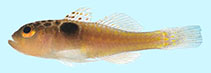
Dorsalspines (total): 7; Dorsalsoft rays (total): 9 - 10; Analspines: 1; Analsoft rays: 8. The species is characterized by the absence of scales on the cheek, opercle and midline of the nape; fifth pelvic fin ray branched sequentially once; a moderate interorbital trench;
a short and narrow postorbital trench; color of living specimens red with a white belly, a large brown-black spot larger than the eye immediately above the pectoral fin base and numerous smaller dark spots across the nape; and in preserved specimens the dark spots remain but the ground color is yellow. Differs from its congeners by the very large 1.25 eye diameter brown-black spot above the pectoral fin base and the rows of smaller brown spots on the nape separated by a honeycomb pattern (Ref. 59339). Body shape (shape guide): fusiform / normal.
Life cycle and mating behavior Maturity | Reproduction | Spawning | Eggs | Fecundity | Larvae
Winterbottom, R. and M. Zur, 2007. Three new species of genus Trimma from Palau (Percomorpha: Gobioidei). aqua, Int. J. Ichthyol. 13(1):13-24. (Ref. 59339)
IUCN Red List Status (Ref. 130435: Version 2025-2 (Global))