



Ungusurculus philippinensis Schwarzhans & Møller, 2007
Philippines viviparous brotula
Add your observation in Fish Watcher
| Native range | All suitable habitat | Point map | Year 2050 |

|
| This map was computer-generated and has not yet been reviewed. |
| Ungusurculus philippinensis AquaMaps Data sources: GBIF OBIS |
Upload your photos and videos
Pictures | Google image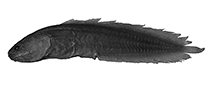 Ungusurculus philippinensis
Male Picture by W. Schwarzhans & P. R. Møller
Pictures | Google image
Male Picture by W. Schwarzhans & P. R. Møller
Classification / Names Common names | Synonyms | Catalog of Fishes(genus, species) | ITIS | CoL | WoRMS | Cloffa
Teleostei (teleosts) > Ophidiiformes (Cusk eels) > Dinematichthyidae (Viviparous brotula)
Etymology: Ungusurculus: Name from Latin words 'ungulus' (= claw) and 'surculus' (= grapevine tendril), refers to the functional analogy with the pseudoclaspers and the specific shape of the inner pseudoclasper; philippinensis: Named for the Philippine Islands, its area of distribution.
More on authors: Schwarzhans & Møller.
Etymology: Ungusurculus: Name from Latin words 'ungulus' (= claw) and 'surculus' (= grapevine tendril), refers to the functional analogy with the pseudoclaspers and the specific shape of the inner pseudoclasper; philippinensis: Named for the Philippine Islands, its area of distribution.
More on authors: Schwarzhans & Møller.
Environment: milieu / climate zone / depth range / distribution range Ecology
Marine; reef-associated; depth range 5 - 10 m (Ref. 90102). Tropical
Distribution Territories | FAO areas | Ecosystems | Occurrences | Point map | Introductions | Faunafri
Western Pacific: Philippines.
Size / Weight / Age
Short description Identification keys | Morphology | Morphometrics
Dorsal soft rays (total): 78 - 87; Anal soft rays: 54 - 66; Vertebrae: 42 - 44. This species is distinct with the following characters: D 78-87, A 54-66, D/A 22-27, V in D 2.2-2.4; vertebrae 12-13+29-32=42-44; anterior nostril located 1/4 the distance from upper lip to aggregate distance to anterior margin of eye; free pseudoclaspers 2 pairs, outer pseudoclasper wing-shaped with broad base and distally slightly widened supporter without anterior hook, the inner one moderately long, with widened base, distally with 2 inward directed strong spines; cheeks with 5-6 scale rows on upper part and 3-4 rows on lower; no upper preopercular pore; otolith moderately elongate, its length to height is 2.0-2.1, pointed anterior and posterior tips, short sulcus with ventral indentation at joining of ostium and cauda, partly fused colliculi, its centre anterior to centre of otolith, inclined about 10°, otolith length to sulcus length is 2.0-2.1 (Ref. 76869).
Body shape (shape guide): elongated; Cross section: compressed.
Body shape (shape guide): elongated; Cross section: compressed.
Inhabitant of reef crevices, cryptic and solitary (Ref 90102).
Life cycle and mating behavior Maturity | Reproduction | Spawning | Eggs | Fecundity | Larvae
Main reference
Upload your references | References | Coordinator | Collaborators
Schwarzhans, W. and P.R. Møller, 2007. Review of the Dinematichthyini (Teleostei: Bythitidae) of the Indo-west Pacific. Part III. Beaglichthys, Brosmolus, Monothrix and eight new genera with description of 20 new species. The Beagle, Records of the Museums and Art Galleries of the Northern Territory 23:29-110. (Ref. 76869)
IUCN Red List Status (Ref. 130435: Version 2025-2 (Global))
Least Concern (LC) ; Date assessed: 02 March 2017
CITES
Not Evaluated
Threat to humans
Human uses
Fisheries: of no interest
FAO - Publication: search | FishSource |
More information
Trophic ecology
Food items (preys)
Diet composition
Food consumption
Food rations
Predators
Food items (preys)
Diet composition
Food consumption
Food rations
Predators
Ecology
Ecology
Ecology
Population dynamics
Growth parameters
Max. ages / sizes
Length-weight rel.
Length-length rel.
Length-frequencies
Mass conversion
Recruitment
Abundance
Growth parameters
Max. ages / sizes
Length-weight rel.
Length-length rel.
Length-frequencies
Mass conversion
Recruitment
Abundance
Life cycle
Reproduction
Maturity
Maturity/Gills rel.
Fecundity
Spawning
Spawning aggregations
Eggs
Egg development
Larvae
Larval dynamics
Reproduction
Maturity
Maturity/Gills rel.
Fecundity
Spawning
Spawning aggregations
Eggs
Egg development
Larvae
Larval dynamics
Anatomy
Gill area
Brain
Otolith
Gill area
Brain
Otolith
Physiology
Body composition
Nutrients
Oxygen consumption
Swimming type
Swimming speed
Visual pigments
Fish sound
Diseases & Parasites
Toxicity (LC50s)
Body composition
Nutrients
Oxygen consumption
Swimming type
Swimming speed
Visual pigments
Fish sound
Diseases & Parasites
Toxicity (LC50s)
Genetics
Genome
Genetics
Heterozygosity
Heritability
Genetic Diversity
Genome
Genetics
Heterozygosity
Heritability
Genetic Diversity
Human related
Aquaculture systems
Aquaculture profiles
Strains
Ciguatera cases
Stamps, coins, misc.
Aquaculture systems
Aquaculture profiles
Strains
Ciguatera cases
Stamps, coins, misc.
Tools
Special reports
Download XML
Internet sources
AFORO (otoliths) | Aquatic Commons | BHL | Cloffa | Websites from users | Check FishWatcher | CISTI | Catalog of Fishes: genus, species | DiscoverLife | ECOTOX | FAO - Publication: search | Faunafri | Fishipedia | Fishtrace | GloBI | Google Books | Google Scholar | Google | IGFA World Record | OneZoom | Open Tree of Life | Otolith Atlas of Taiwan Fishes | PubMed | Reef Life Survey | Socotra Atlas | TreeBase | Tree of Life | Wikipedia: Go, Search | | Zoobank | Zoological Record
Estimates based on models
|
Phylogenetic diversity index (Ref. 82804) |
PD50 = 0.5156 [Uniqueness, from 0.5 = low to 2.0 = high]. |
| Bayesian length-weight | a=0.00389 (0.00180 - 0.00842), b=3.12 (2.94 - 3.30), in cm total length, based on all LWR estimates for this body shape (Ref. 93245). |
|
Trophic level (Ref. 69278) |
3.2 ±0.5 se; based on size and trophs of closest relatives |
|
Fishing Vulnerability (Ref. 59153) |
Low vulnerability (10 of 100). 🛈 |