This website uses cookies to enhance your browsing experience and ensure the functionality of our site. For more detailed information about the types of cookies we use and how we protect your privacy, please visit our Privacy Information page.
×
Cookie Settings
This website uses different types of cookies to enhance your experience. Please select your preferences below:
Teleostei (teleosts) > Gobiiformes (Gobies) > Gobiidae (Gobies) > Gobiinae
Etymology: Trimma:Greek, trimma, -atos = something crushed (Ref. 45335); caudipunctatum:Named for the distinctive polka dots on the caudal fin (Latin cauda for tail and punctatum meaning spot).
Environment: milieu / climate zone / depth range / distribution range Ecology
Marine; benthopelagic; depth range 40 - 70 m (Ref. 81089). Subtropical
Maturity: Lm? range ? - ? cm Max length : 2.1 cm SL male/unsexed; (Ref. 81089); 1.7 cm SL (female)
Short description Identification keys | Morphology | Morphometrics
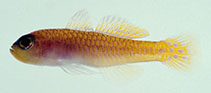
Dorsalspines (total): 7; Dorsalsoft rays (total): 9; Analspines: 1; Analsoft rays: 8 - 9; Vertebrae: 26. This specie sis distinguished by the following characters: 7 predorsal scales; 9 second dorsal-fin rays; all pectoral fin rays unbranched; first dorsal fin with no elongate and filamentous spines; fifth pelvic-fin ray unbranched; no basal membrane; no interorbital trough; 2 embedded cycloid scales dorsally on opercle; head and body light reddish yellow; fresh and color in life of snout, interorbit, and upper and lower parts of eye dark purplish blue; caudal fin vivid yellow with pale lavender polka dots (Ref. 81089). Body shape (shape guide): fusiform / normal.
Life cycle and mating behavior Maturity | Reproduction | Spawning | Eggs | Fecundity | Larvae
Suzuki, T. and H. Senou, 2009. Two new species of the genus Trumma (Perciformes: Gobiidae) from Japan and Palau. Bull. Kanagawa Prefect. Mus. (Nat. Sci.) 38:107-112. (Ref. 81089)
IUCN Red List Status (Ref. 130435: Version 2025-2 (Global))