



Hoplostethus robustispinus Moore & Dodd, 2010
Thickspine roughy
Upload your photos and videos
Pictures | Google image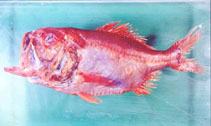 Hoplostethus robustispinus
Male Picture by Moore, J.
Pictures | Google image
Male Picture by Moore, J.
Classification / Names Common names | Synonyms | Catalog of Fishes(genus, species) | ITIS | CoL | WoRMS | Cloffa
Teleostei (teleosts) > Trachichthyiformes (Roughies) > Trachichthyidae (Slimeheads)
Etymology: Hoplostethus: Greek, hoplon = weapon + Greek, stetho, stethion = brest; literal = to prick a little breast (Ref. 45335); robustispinus: Name from the combination of the Latin robustus, meaning strong, and spinus, for spine, in reference to the extremely thickened fin spines (Ref. 84133).
Etymology: Hoplostethus: Greek, hoplon = weapon + Greek, stetho, stethion = brest; literal = to prick a little breast (Ref. 45335); robustispinus: Name from the combination of the Latin robustus, meaning strong, and spinus, for spine, in reference to the extremely thickened fin spines (Ref. 84133).
Environment: milieu / climate zone / depth range / distribution range Ecology
Marine; demersal; depth range ? - 660 m (Ref. 84133). Tropical; 28°N - 15°N, 123°E - 129°E
Distribution Territories | FAO areas | Ecosystems | Occurrences | Point map | Introductions | Faunafri
Northwestern Pacific: Philippines (east of Calagua Islands) and Japan.
Size / Weight / Age
Short description Identification keys | Morphology | Morphometrics
Dorsal spines (total): 6; Dorsal soft rays (total): 14; Anal spines: 3; Anal soft rays: 9; Vertebrae: 27. Hoplostethus robustispinus has extremely thickened fin spines, 56 digitiform pyloric caeca, a bright red body, fins with no black pigment in any fin membranes, no silvery flanks, a long trunk (VA distance is greater than almost all other species) and eyes more dorsally placed, with the upper margin dorsal to preopercular ridges and level with the post-temporal spine (Ref. 84133).
Body shape (shape guide): short and / or deep.
Body shape (shape guide): short and / or deep.
Life cycle and mating behavior Maturity | Reproduction | Spawning | Eggs | Fecundity | Larvae
Main reference
Upload your references | References | Coordinator : Moore, Jon A. | Collaborators
Moore, J.A. and K.A. Dodd, 2010. A New Species of the Roughy Genus Hoplostethus (Teleostei: Trachichthyidae) from the Philippines. Bulletin of the Peabody Museum of Natural History 51(1):137-144. (Ref. 84133)
IUCN Red List Status (Ref. 130435: Version 2025-2 (Global))
Least Concern (LC) ; Date assessed: 31 December 2019
CITES
Not Evaluated
Threat to humans
Harmless
Human uses
FAO - Publication: search | FishSource |
More information
Trophic ecology
Food items (preys)
Diet composition
Food consumption
Food rations
Predators
Food items (preys)
Diet composition
Food consumption
Food rations
Predators
Ecology
Ecology
Ecology
Population dynamics
Growth parameters
Max. ages / sizes
Length-weight rel.
Length-length rel.
Length-frequencies
Mass conversion
Recruitment
Abundance
Growth parameters
Max. ages / sizes
Length-weight rel.
Length-length rel.
Length-frequencies
Mass conversion
Recruitment
Abundance
Life cycle
Reproduction
Maturity
Maturity/Gills rel.
Fecundity
Spawning
Spawning aggregations
Eggs
Egg development
Larvae
Larval dynamics
Reproduction
Maturity
Maturity/Gills rel.
Fecundity
Spawning
Spawning aggregations
Eggs
Egg development
Larvae
Larval dynamics
Anatomy
Gill area
Brain
Otolith
Gill area
Brain
Otolith
Physiology
Body composition
Nutrients
Oxygen consumption
Swimming type
Swimming speed
Visual pigments
Fish sound
Diseases & Parasites
Toxicity (LC50s)
Body composition
Nutrients
Oxygen consumption
Swimming type
Swimming speed
Visual pigments
Fish sound
Diseases & Parasites
Toxicity (LC50s)
Genetics
Genome
Genetics
Heterozygosity
Heritability
Genetic Diversity
Genome
Genetics
Heterozygosity
Heritability
Genetic Diversity
Human related
Aquaculture systems
Aquaculture profiles
Strains
Ciguatera cases
Stamps, coins, misc.
Aquaculture systems
Aquaculture profiles
Strains
Ciguatera cases
Stamps, coins, misc.
Tools
Special reports
Download XML
Internet sources
AFORO (otoliths) | Aquatic Commons | BHL | Cloffa | Websites from users | Check FishWatcher | CISTI | Catalog of Fishes: genus, species | DiscoverLife | ECOTOX | FAO - Publication: search | Faunafri | Fishipedia | Fishtrace | GloBI | Google Books | Google Scholar | Google | IGFA World Record | OneZoom | Open Tree of Life | Otolith Atlas of Taiwan Fishes | PubMed | Reef Life Survey | Socotra Atlas | TreeBase | Tree of Life | Wikipedia: Go, Search | World Records Freshwater Fishing | Zoobank | Zoological Record
Estimates based on models
Phylogenetic diversity index (Ref. 82804): PD50 = 0.5000 [Uniqueness, from 0.5 = low to 2.0 = high].
Bayesian length-weight: a=0.01660 (0.00717 - 0.03842), b=3.05 (2.86 - 3.24), in cm total length, based on LWR estimates for this (Sub)family-body shape (Ref. 93245).
Trophic level (Ref. 69278): 3.6 ±0.6 se; based on size and trophs of closest relatives
Resilience (Ref. 120179): Very Low, minimum population doubling time more than 14 years (Preliminary K or Fecundity.).