



Upload your photos and videos
Google image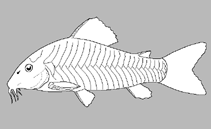 No image available for this species;
drawing shows typical species in Callichthyidae.
Google image
drawing shows typical species in Callichthyidae.
Classification / Names Common names | Synonyms | Catalog of Fishes(genus, species) | ITIS | CoL | WoRMS | Cloffa
Teleostei (teleosts) > Siluriformes (Catfishes) > Callichthyidae (Callichthyid armored catfishes) > Corydoradinae
Environment: milieu / climate zone / depth range / distribution range Ecology
Freshwater; demersal; depth range 0 - 1 m (Ref. 138443). Tropical
Distribution Territories | FAO areas | Ecosystems | Occurrences | Point map | Introductions | Faunafri
South America: Brazil.
Size / Weight / Age
Short description Identification keys | Morphology | Morphometrics
This species is distinguished by the following characters: with posterior margin of pectoral-fin spine with most serrations directed towards the tip of the spine; presence of contact between nuchal plate and posterior process of the parieto-supraoccipital; absence of a large-sized dark blotch on caudal-fin base; posterodorsal edge of infraorbital 2 only in contact with sphenotic; absence of conspicuous dark brown or black markings on body; dark markings, when present, diffuse; posterior laminar expansion of infraorbital 2 strongly reduced, nearly imperceptible in some specimens, slender body, and narrow frontal bone; presence of ventral surface of trunk only with small-sized, irregular platelets; anterior portion of dorsal fin with scattered dark brown or black chromatophores, not forming any conspicuous pattern; dorsal surface of snout with numerous platelets bearing odontodes (Ref. 138443).
Body shape (shape guide): fusiform / normal; Cross section: oval.
Body shape (shape guide): fusiform / normal; Cross section: oval.
Inhabits the rio Jamanxim and at least one of its tributaries, the igarapé Santa Júlia. In the rio Jamanxim, it was mostly associated along the margins of the river, where juvenile and adult specimens were observed in the shallow (up to about 20 cm deep) sandy shores with slow water flow. In the igarapé Santa Júlia, both juvenile and adult specimens were also observed in marginal shallow (up to about 20 cm deep) portions, with more complex substrate, mainly composed by sand, fine gravel and larger rocks. In both sampled sites, the new species was mostly captured at night (Ref. 138443).
Life cycle and mating behavior Maturity | Reproduction | Spawning | Eggs | Fecundity | Larvae
Main reference
Upload your references | References | Coordinator : Reis, Roberto E. | Collaborators
Tencatt, L.F.C., W.M. Ohara, L.M. de Sousa and M.R. Britto, 2022. Science and hobby joining forces for the discovery of three new Corydoras (Siluriformes: Callichthyidae) from the rio Tapajós basin, Brazil, with comments on Corydoras sp. CW111. Neotropical Ichthyology v. 20 (no. 3): e220070: 1-40. (Ref. 138443)
CITES
Not Evaluated
Threat to humans
Harmless
Human uses
FAO - Publication: search | FishSource |
More information
Trophic ecology
Food items (preys)
Diet composition
Food consumption
Food rations
Predators
Food items (preys)
Diet composition
Food consumption
Food rations
Predators
Ecology
Ecology
Ecology
Population dynamics
Growth parameters
Max. ages / sizes
Length-weight rel.
Length-length rel.
Length-frequencies
Mass conversion
Recruitment
Abundance
Growth parameters
Max. ages / sizes
Length-weight rel.
Length-length rel.
Length-frequencies
Mass conversion
Recruitment
Abundance
Life cycle
Reproduction
Maturity
Maturity/Gills rel.
Fecundity
Spawning
Spawning aggregations
Eggs
Egg development
Larvae
Larval dynamics
Reproduction
Maturity
Maturity/Gills rel.
Fecundity
Spawning
Spawning aggregations
Eggs
Egg development
Larvae
Larval dynamics
Anatomy
Gill area
Brain
Otolith
Gill area
Brain
Otolith
Physiology
Body composition
Nutrients
Oxygen consumption
Swimming type
Swimming speed
Visual pigments
Fish sound
Diseases & Parasites
Toxicity (LC50s)
Body composition
Nutrients
Oxygen consumption
Swimming type
Swimming speed
Visual pigments
Fish sound
Diseases & Parasites
Toxicity (LC50s)
Genetics
Genome
Genetics
Heterozygosity
Heritability
Genetic Diversity
Genome
Genetics
Heterozygosity
Heritability
Genetic Diversity
Human related
Aquaculture systems
Aquaculture profiles
Strains
Ciguatera cases
Stamps, coins, misc.
Aquaculture systems
Aquaculture profiles
Strains
Ciguatera cases
Stamps, coins, misc.
Tools
Special reports
Download XML
Internet sources
AFORO (otoliths) | Aquatic Commons | BHL | Cloffa | Websites from users | Check FishWatcher | CISTI | Catalog of Fishes: genus, species | DiscoverLife | ECOTOX | FAO - Publication: search | Faunafri | Fishipedia | Fishtrace | GloBI | Google Books | Google Scholar | Google | IGFA World Record | OneZoom | Open Tree of Life | Otolith Atlas of Taiwan Fishes | PubMed | Reef Life Survey | Socotra Atlas | TreeBase | Tree of Life | Wikipedia: Go, Search | | Zoological Record
Estimates based on models
|
Phylogenetic diversity index (Ref. 82804) |
PD50 = 0.5000 [Uniqueness, from 0.5 = low to 2.0 = high]. |
| Bayesian length-weight | a=0.01820 (0.00782 - 0.04232), b=3.02 (2.82 - 3.22), in cm total length, based on LWR estimates for this (Sub)family-body shape (Ref. 93245). |
|
Trophic level (Ref. 69278) |
3.0 ±0.4 se; based on size and trophs of closest relatives |
|
Resilience (Ref. 120179) |
High, minimum population doubling time less than 15 months (Preliminary K or Fecundity.). |
|
Fishing Vulnerability (Ref. 59153) |
Low vulnerability (10 of 100). 🛈 |