



Upload your photos and videos
Google image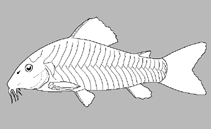 No image available for this species;
drawing shows typical species in Callichthyidae.
Google image
drawing shows typical species in Callichthyidae.
Classification / Names Common names | Synonyms | Catalog of Fishes(genus, species) | ITIS | CoL | WoRMS | Cloffa
Teleostei (teleosts) > Siluriformes (Catfishes) > Callichthyidae (Callichthyid armored catfishes) > Corydoradinae
Etymology: Corydoras: Greek, kory = helmet + greek, doras = skin (Ref. 45335); iiap: Named for the Instituto de Investigaciones de la Amazonía Peruana (IIAP), in Loreto, Peru, which has been the center for the study of the biodiversity of the Peruvian Amazon for over four decades; noun in apposition.
Etymology: Corydoras: Greek, kory = helmet + greek, doras = skin (Ref. 45335); iiap: Named for the Instituto de Investigaciones de la Amazonía Peruana (IIAP), in Loreto, Peru, which has been the center for the study of the biodiversity of the Peruvian Amazon for over four decades; noun in apposition.
Environment: milieu / climate zone / depth range / distribution range Ecology
Freshwater; demersal; pH range: 5.4 - 6.3; depth range 1 - 1 m (Ref. 138496). Tropical; 25°C - 27°C (Ref. 138496)
Distribution Territories | FAO areas | Ecosystems | Occurrences | Point map | Introductions | Faunafri
South America: Peru.
Size / Weight / Age
Short description Identification keys | Morphology | Morphometrics
This species is distinguished from its congeners by the following characters: with branch of the temporal sensory canal at sphenotic, which gives rise to the supraorbital canal, with two pores; upper tooth plate of branchial arch with three series of teeth; the area at the corner of the mouth, ventral to the maxillary barbel, with a small, triangular fleshy flap, which may variably present a small prolongation at its posterior tip, forming a short barbel-like structure; with a conspicuous dark brown or black patch transversally crossing the orbit, forming a mask-like blotch; absence of a distinct color pattern along midline of flank; with dorsolateral body plates only with small, irregular, rounded or vertically elongated dark brown or black blotches; ground color of plates typically light yellow or beige; absence of a relatively large, conspicuous dark patch on anterior portion of dorsal fin; with dorso- and ventrolateral body plates with pale yellow or beige background coloration, with dark blotches on flanks conspicuously standing out from the ground color of plates; with a conspicuous mask-like blotch; with ossified portion of hypobranchial 2 ranging from moderately developed, with size similar to cartilaginous portion, to well developed, around twice size of cartilaginous portion, even in smaller specimens with up to about 4.2 cm SL (Ref. 138496).
Body shape (shape guide): short and / or deep; Cross section: oval.
Body shape (shape guide): short and / or deep; Cross section: oval.
This species was collected in streams with black, muddy, and mixed waters, all tributaries of the Ríos Itaya and Nanay. The sampled environments are first-order streams, with constant fluctuations in water level influenced mainly by local rainfall. These aquatic environments with width ranging from 4 to 8.1 m, depth ranging from 0.6 to 1.3 m. On the average, physicochemical parameters of the type-locality are the following: water temperature 26.2°C, pH 6.3, dissolved oxygen 2.4 mg/l, electrical conductivity of 30.5 µS/cm, and total suspended solids 15.0 mg/l. For other sampled localities, the average parameters were: water temperature between 24.5°C and 27.0°C, pH between 5.4 and 5.5, dissolved oxygen between 3.8 and 5.4 mg/l, electrical conductivity between 17.0 and 28.0 µS/cm, and total suspended solids between 8.0 and 14.0 mg/l. The substrate was mostly composed by sand, with some decomposing plant material. In most sampled streams,This species was observed in syntopy with C. sychri and C. ambiacus (Ref. 138496).
Life cycle and mating behavior Maturity | Reproduction | Spawning | Eggs | Fecundity | Larvae
Main reference
Upload your references | References | Coordinator : Reis, Roberto E. | Collaborators
Tencatt, L.F.C.,, M. Ruiz-Tafur and J. Chuctaya, 2024. A new masked Corydoras (Siluriformes: Callichthyidae) from the Itaya and Nanay River basins, Peruvian Amazon. Neotropical Ichthyol.. 22(2):e240016:1-26. (Ref. 138496)
CITES
Not Evaluated
Threat to humans
Harmless
Human uses
FAO - Publication: search | FishSource |
More information
Trophic ecology
Food items (preys)
Diet composition
Food consumption
Food rations
Predators
Food items (preys)
Diet composition
Food consumption
Food rations
Predators
Ecology
Ecology
Ecology
Population dynamics
Growth parameters
Max. ages / sizes
Length-weight rel.
Length-length rel.
Length-frequencies
Mass conversion
Recruitment
Abundance
Growth parameters
Max. ages / sizes
Length-weight rel.
Length-length rel.
Length-frequencies
Mass conversion
Recruitment
Abundance
Life cycle
Reproduction
Maturity
Maturity/Gills rel.
Fecundity
Spawning
Spawning aggregations
Eggs
Egg development
Larvae
Larval dynamics
Reproduction
Maturity
Maturity/Gills rel.
Fecundity
Spawning
Spawning aggregations
Eggs
Egg development
Larvae
Larval dynamics
Anatomy
Gill area
Brain
Otolith
Gill area
Brain
Otolith
Physiology
Body composition
Nutrients
Oxygen consumption
Swimming type
Swimming speed
Visual pigments
Fish sound
Diseases & Parasites
Toxicity (LC50s)
Body composition
Nutrients
Oxygen consumption
Swimming type
Swimming speed
Visual pigments
Fish sound
Diseases & Parasites
Toxicity (LC50s)
Genetics
Genome
Genetics
Heterozygosity
Heritability
Genetic Diversity
Genome
Genetics
Heterozygosity
Heritability
Genetic Diversity
Human related
Aquaculture systems
Aquaculture profiles
Strains
Ciguatera cases
Stamps, coins, misc.
Aquaculture systems
Aquaculture profiles
Strains
Ciguatera cases
Stamps, coins, misc.
Tools
Special reports
Download XML
Internet sources
AFORO (otoliths) | Aquatic Commons | BHL | Cloffa | Websites from users | Check FishWatcher | CISTI | Catalog of Fishes: genus, species | DiscoverLife | ECOTOX | FAO - Publication: search | Faunafri | Fishipedia | Fishtrace | GloBI | Google Books | Google Scholar | Google | IGFA World Record | OneZoom | Open Tree of Life | Otolith Atlas of Taiwan Fishes | PubMed | Reef Life Survey | Socotra Atlas | TreeBase | Tree of Life | Wikipedia: Go, Search | | Zoobank | Zoological Record
Estimates based on models
|
Phylogenetic diversity index (Ref. 82804) |
PD50 = 0.5000 [Uniqueness, from 0.5 = low to 2.0 = high]. |
| Bayesian length-weight | a=0.02455 (0.00964 - 0.06248), b=3.00 (2.77 - 3.23), in cm total length, based on LWR estimates for this (Sub)family-body shape (Ref. 93245). |
|
Trophic level (Ref. 69278) |
3.0 ±0.3 se; based on size and trophs of closest relatives |
|
Resilience (Ref. 120179) |
High, minimum population doubling time less than 15 months (Preliminary K or Fecundity.). |
|
Fishing Vulnerability (Ref. 59153) |
Low vulnerability (10 of 100). 🛈 |