Environment: milieu / climate zone / пределы глубины / distribution range
экология
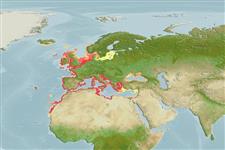
морской; пресноводный; солоноватоводный pelagic-neritic; катадромный (Ref. 51243); пределы глубины 10 - 20 m (Ref. 7399). Temperate; 64°N - 20°N, 26°W - 42°E
Eastern Atlantic: Scotland to Cape Verde; in the Mediterranean and Black Sea. Also in coastal waters from southern Norway to Morocco, rare off Mauritania (Ref. 3573). Records from the lagoon of Accra are probably misidentifications.
Length at first maturity / Size / Вес / Возраст
половая зрелость: Lm 34.0 range ? - ? cm
Max length : 61.0 cm FL самец/пол неопределен; (Ref. 117745); common length : 30.0 cm SL самец/пол неопределен; (Ref. 7399); наибольший вес (опубликованные данные): 2.5 kg (Ref. 117745)
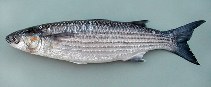
колючие лучи спинного плавника (общее число) : 5; членистые (мягкие) лучи спинного плавника (общее число) : 7 - 9; колючие лучи анального плавника: 3. Longer pectoral fins, lack of black spot at the pectoral fin base. Golden spot present in gill cover (Ref. 35388).
Body shape (shape guide): fusiform / normal.
Adults are neritic usually in schools, entering lagoons and lower estuaries (Ref. 7399); rarely entering freshwater (Ref. 3573, 59043). Juveniles move to coastal lagoons and estuaries in winter and especially in spring (Ref. 59043). They feed on small benthic organisms, detritus, and occasionally on insects and plankton (Ref. 2804). Juveniles feed only on zooplankton (Ref. 59043). Reproduction takes place in the sea, from July to November. Oviparous, eggs are pelagic and non-adhesive (Ref. 205). Minimum size allowed for fishing is 20 cm. The quality of the flesh is variable (Ref. 30578).
Juveniles move to coastal lagoons and estuaries in winter and especially in spring (Ref. 59043).
Thomson, J.M., 1986. Mugilidae. p. 344-349. In J. Daget, J.-P. Gosse and D.F.E. Thys van den Audenaerde (eds.) Check-list of the freshwater fishes of Africa (CLOFFA). ISNB, Brussels, MRAC; Tervuren; and ORSTOM, Paris. Vol. 2. (Ref. 3573)
Статус Красного Списка МСОП (Ref. 130435: Version 2025-1)
Угроза для людей
Harmless
Использование человеком
рыболовство: коммерческий; аквакультура (рыбоводство): коммерческий
дополнительная информация
инструменты
Специальные отчеты
Скачать в формате XML
ресурсы в Интернет
Estimates based on models
Preferred temperature (ссылка
123201): 9.7 - 20.7, mean 11.9 °C (based on 344 cells).
Phylogenetic diversity index (ссылка
82804): PD
50 = 0.5010 [Uniqueness, from 0.5 = low to 2.0 = high].
Bayesian length-weight: a=0.01023 (0.00861 - 0.01216), b=2.96 (2.93 - 2.99), in cm total length, based on LWR estimates for this species (Ref.
93245).
Trophic level (ссылка
69278): 2.8 ±0.33 se; based on food items.
Generation time: 5.5 (3.7 - 6.9) years. Estimated as median ln(3)/K based on 31
growth studies.
устойчивость к внешним воздействиям (ссылка
120179): средний (среднего размера), минимальное время удвоения популяции 1.4-4.4 года (K=0.14-0.34; tm=3-4; tmax=8; Fec>10,000).
Prior r = 0.77, 95% CL = 0.51 - 1.16, Based on 1 data-limited stock assessment.
Fishing Vulnerability (Ref.
59153): Moderate vulnerability (36 of 100).
🛈
Climate Vulnerability (Ref.
125649): Low to moderate vulnerability (35 of 100).
🛈
Nutrients (Ref.
124155): Calcium = 15.9 [5.1, 136.9] mg/100g; Iron = 0.255 [0.151, 0.421] mg/100g; Protein = 18.2 [16.9, 19.7] %; Omega3 = 1.21 [0.47, 3.11] g/100g; Selenium = 2.88 [1.17, 7.25] μg/100g; VitaminA = 12.9 [3.4, 52.7] μg/100g; Zinc = 0.478 [0.334, 0.670] mg/100g (wet weight); based on
nutrient studies.