



Cypselurus hexazona (Bleeker, 1853)
Darkbar flyingfish
Add your observation in Fish Watcher
| Native range | All suitable habitat | Point map | Year 2050 |

|
| This map was computer-generated and has not yet been reviewed. |
| Cypselurus hexazona AquaMaps Data sources: GBIF OBIS |
Upload your photos and videos
Pictures | Google image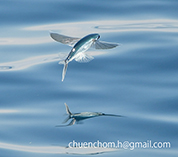 Cypselurus hexazona
Picture by Hansasuta, C.
Pictures | Google image
Picture by Hansasuta, C.
Classification / Names Common names | Synonyms | Catalog of Fishes(genus, species) | ITIS | CoL | WoRMS | Cloffa
Teleostei (teleosts) > Beloniformes (Needle fishes) > Exocoetidae (Flyingfishes)
Etymology: Cypselurus: Greek, kypselos, ou = swift + Greek,oura = tail (Ref. 45335).
More on author: Bleeker.
Etymology: Cypselurus: Greek, kypselos, ou = swift + Greek,oura = tail (Ref. 45335).
More on author: Bleeker.
Environment: milieu / climate zone / depth range / distribution range Ecology
Marine; pelagic-neritic; oceanodromous (Ref. 51243); depth range 0 - 20 m. Tropical; - 35°S
Distribution Territories | FAO areas | Ecosystems | Occurrences | Point map | Introductions | Faunafri
Indo-West Pacific: Red Sea to Philippines, Viet Nam, New Guinea, and New South Wales, Australia.
Size / Weight / Age
Short description Identification keys | Morphology | Morphometrics
This elongated and broadly cylindrical species is distinguished by having the following characters: pectoral fins high on sides, strikingly long, always extending beyond dorsal-fin origin; no spines on fins; small and conical teeth in jaws in one irregular row; no three-cuspid teeth; no palatine teeth; juveniles (25-60 mm) without barbel and with six bands on belly (Ref. 87965).
Body shape (shape guide): elongated; Cross section: oval.
Body shape (shape guide): elongated; Cross section: oval.
Found in near-shore surface waters, never spread to open sea. Feeds on zooplankton and small fish (Ref. 9839).
Life cycle and mating behavior Maturity | Reproduction | Spawning | Eggs | Fecundity | Larvae
Main reference
Upload your references | References | Coordinator : Parin, Nikolay V. | Collaborators
Parin, N.V., 1996. On the species composition of flying fishes (Exocoetidae) in the West-Central part of tropical Pacific. J. Ichthyol. 36(5):357-364. (Ref. 27313)
CITES
Not Evaluated
Threat to humans
Harmless
Human uses
Fisheries: of no interest
FAO - Publication: search | FishSource |
More information
Population dynamics
Growth parameters
Max. ages / sizes
Length-weight rel.
Length-length rel.
Length-frequencies
Mass conversion
Recruitment
Abundance
Growth parameters
Max. ages / sizes
Length-weight rel.
Length-length rel.
Length-frequencies
Mass conversion
Recruitment
Abundance
Life cycle
Reproduction
Maturity
Maturity/Gills rel.
Fecundity
Spawning
Spawning aggregations
Eggs
Egg development
Larvae
Larval dynamics
Reproduction
Maturity
Maturity/Gills rel.
Fecundity
Spawning
Spawning aggregations
Eggs
Egg development
Larvae
Larval dynamics
Anatomy
Gill area
Brain
Otolith
Gill area
Brain
Otolith
Physiology
Body composition
Nutrients
Oxygen consumption
Swimming type
Swimming speed
Visual pigments
Fish sound
Diseases & Parasites
Toxicity (LC50s)
Body composition
Nutrients
Oxygen consumption
Swimming type
Swimming speed
Visual pigments
Fish sound
Diseases & Parasites
Toxicity (LC50s)
Genetics
Genome
Genetics
Heterozygosity
Heritability
Genetic Diversity
Genome
Genetics
Heterozygosity
Heritability
Genetic Diversity
Human related
Aquaculture systems
Aquaculture profiles
Strains
Ciguatera cases
Stamps, coins, misc.
Aquaculture systems
Aquaculture profiles
Strains
Ciguatera cases
Stamps, coins, misc.