-

- About this page
- Languages
- User feedbacks
- Citation
- Uploads
- Related species
-



Upload your photos and videos
Pictures | Google image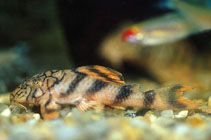 Peckoltia braueri
Picture by JJPhoto
Pictures | Google image
Picture by JJPhoto
Classification / Names Common names | Synonyms | Catalog of Fishes(genus, species) | ITIS | CoL | WoRMS | Cloffa
Teleostei (teleosts) > Siluriformes (Catfishes) > Loricariidae (Armored catfishes) > Hypostominae
Etymology: Peckoltia: Because of Gustavo Peckolt,member of the Natural History Commission of Rondon (Ref. 45335).
Eponymy: Gustavo Peckolt (1861–1923) was a Brazilian-born German botanist and pharmacist. [...] Professor Dr August Bernhard Brauer (1863–1917) was a German herpetologist and ichthyologist. [...] (Ref. 128868), visit book page.
More on author: Eigenmann.
Etymology: Peckoltia: Because of Gustavo Peckolt,member of the Natural History Commission of Rondon (Ref. 45335).
Eponymy: Gustavo Peckolt (1861–1923) was a Brazilian-born German botanist and pharmacist. [...] Professor Dr August Bernhard Brauer (1863–1917) was a German herpetologist and ichthyologist. [...] (Ref. 128868), visit book page.
More on author: Eigenmann.
Issue
No recent work; short redescription including the future type specimens in a footnote by Kner (1854:281).
Environment: milieu / climate zone / depth range / distribution range Ecology
Freshwater; demersal. Tropical
Distribution Territories | FAO areas | Ecosystems | Occurrences | Point map | Introductions | Faunafri
South America: Guyana and Brazil.
Size / Weight / Age
Short description Identification keys | Morphology | Morphometrics
Dorsal spines (total): 2; Dorsal soft rays (total): 7; Anal spines: 1; Anal soft rays: 4. Distinguished from all other species of Peckoltia except P. cavaticaby having an orange band in the dorsal fin and by having thin, wavy, black lines that tend to outline the plates and bones of the head. Differs from P. cavatica by having the dorsal saddles better developed, by having the head plates and bones completely outlined in black and with lines intense, by having black vermiculations on the pterotic-supracleithrum, by having at least one, broken band in the caudal fin, and by having the marginal orange band of the dorsal and caudal fins not as thick or as intense as in P. cavatica (Ref. 54521).
Body shape (shape guide): elongated.
Body shape (shape guide): elongated.
Facultative air-breathing in the genus (Ref. 126274); Inhabits swift riffles among very large boulders (Ref. 54521).
Life cycle and mating behavior Maturity | Reproduction | Spawning | Eggs | Fecundity | Larvae
Main reference
Upload your references | References | Coordinator : Fisch-Muller, Sonia | Collaborators
Fisch-Muller, S., 2003. Loricariidae-Ancistrinae (Armored catfishes). p. 373-400. In R.E. Reis, S.O. Kullander and C.J. Ferraris, Jr. (eds.) Checklist of the Freshwater Fishes of South and Central America. Porto Alegre: EDIPUCRS, Brasil. (Ref. 36713)
IUCN Red List Status (Ref. 130435: Version 2025-2)
Least Concern (LC) ; Date assessed: 28 October 2020
CITES
Not Evaluated
Threat to humans
Harmless
Human uses
FAO - Publication: search | FishSource |
More information
Trophic ecology
Food items (preys)
Diet composition
Food consumption
Food rations
Predators
Food items (preys)
Diet composition
Food consumption
Food rations
Predators
Ecology
Ecology
Ecology
Population dynamics
Growth parameters
Max. ages / sizes
Length-weight rel.
Length-length rel.
Length-frequencies
Mass conversion
Recruitment
Abundance
Growth parameters
Max. ages / sizes
Length-weight rel.
Length-length rel.
Length-frequencies
Mass conversion
Recruitment
Abundance
Life cycle
Reproduction
Maturity
Maturity/Gills rel.
Fecundity
Spawning
Spawning aggregations
Eggs
Egg development
Larvae
Larval dynamics
Reproduction
Maturity
Maturity/Gills rel.
Fecundity
Spawning
Spawning aggregations
Eggs
Egg development
Larvae
Larval dynamics
Anatomy
Gill area
Brain
Otolith
Gill area
Brain
Otolith
Physiology
Body composition
Nutrients
Oxygen consumption
Swimming type
Swimming speed
Visual pigments
Fish sound
Diseases & Parasites
Toxicity (LC50s)
Body composition
Nutrients
Oxygen consumption
Swimming type
Swimming speed
Visual pigments
Fish sound
Diseases & Parasites
Toxicity (LC50s)
Genetics
Genome
Genetics
Heterozygosity
Heritability
Genetic Diversity
Genome
Genetics
Heterozygosity
Heritability
Genetic Diversity
Human related
Aquaculture systems
Aquaculture profiles
Strains
Ciguatera cases
Stamps, coins, misc.
Aquaculture systems
Aquaculture profiles
Strains
Ciguatera cases
Stamps, coins, misc.
Tools
Special reports
Download XML
Internet sources
AFORO (otoliths) | Aquatic Commons | BHL | Cloffa | Websites from users | Check FishWatcher | CISTI | Catalog of Fishes: genus, species | DiscoverLife | ECOTOX | FAO - Publication: search | Faunafri | Fishipedia | Fishtrace | GloBI | Google Books | Google Scholar | Google | IGFA World Record | OneZoom | Open Tree of Life | Otolith Atlas of Taiwan Fishes | PubMed | Reef Life Survey | Socotra Atlas | TreeBase | Tree of Life | Wikipedia: Go, Search |