



Rhina ancylostomus Bloch & Schneider, 1801
Bowmouth guitarfish
muatnaik fotos/gambar dan video
Gambar | video | imej Google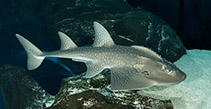 Rhina ancylostomus
foto/gambar oleh Awai, M.
Gambar | video | imej Google
foto/gambar oleh Awai, M.
klasifikasi / Nama Nama-nama umum | Sinonim (persamaan) | Catalog of Fishes(Marga, Jenis) | ITIS | CoL | WoRMS | Cloffa
Ikan bertulang rawan (sharks and rays) > Rhinopristiformes (Shovelnose rays) > Rhinidae (Wedgefishes)
Etymology: Rhina: Greek, rhinos = nose (Ref. 45335).
More on authors: Bloch & Schneider.
Etymology: Rhina: Greek, rhinos = nose (Ref. 45335).
More on authors: Bloch & Schneider.
Taxonomic Remarks
Spelling following ECoF.
Lingkungan: lingkungan / zona iklim / kisaran kedalaman / jangkauan distribusi Ekologi
laut berasosiasi dengan karang; kisaran kedalaman 3 - 90 m (Ref. 30573). Tropical; 42°N - 34°S, 30°E - 170°E (Ref. 114953)
Penyebaran Wilayah | Daerah-daerah FAO | Ekosistem | Kemunculan | peta titik | Introduksi | Faunafri
Indo-West Pacific, from South Africa (Natal coast), Mozambique, East Africa, Seychelles, the Red Sea, Arabia, Oman, the Persian Gulf, India, Sri Lanka, Malaysia, Indonesia (Borneo), Philippines, New Guinea, Thailand, Viet Nam, China, Taiwan Province of China, Korea, Japan, and Australia.
Panjang pada saat jatuh tempo pertama / Ukuran / Berat / umur
Kematangan: Lm 164.0, range 150 - 178 cm
Max length : 300 cm TL jantan/; (Ref. 58784); Berat maksimum terpublikasi: 135.0 kg (Ref. 9987)
Max length : 300 cm TL jantan/; (Ref. 58784); Berat maksimum terpublikasi: 135.0 kg (Ref. 9987)
deskripsi pendek Kunci identifiaksi (pengenalan) | Morfologi | Morfometrik
An unmistakable guitarfish with a broad, rounded snout, large, high pectoral fins, and heavy ridges of spiky thorns over the eyes and on the back and shoulders; jaws with heavily ridged, crushing teeth in undulating rows (Ref. 5578). Grey or brownish above (Ref. 5578), white below; numerous white spots dorsally on fins, body and tail; black spots on head and shoulders but no eyespots or ocelli (Ref. 3919).
Body shape (shape guide): elongated.
Body shape (shape guide): elongated.
Inhabits coastal areas and offshore coral reefs, close inshore (Ref. 9915). Found on sand and mud bottoms (Ref. 12951). Sometimes found in the water column (Ref. 12951). Feeds on demersal bony fishes (e.g. croakers), crustaceans (crabs, prawns), bivalves, and cephalopods (Ref. 9915, 114953). Ovoviviparous (Ref. 50449). Produces litters of 2-11 pups (Ref. 114953). A row of large spines present above the eye, on the center of the nape, and on the shoulder have a defensive function (can be used for butting). Caught commonly by demersal tangle net, and occasionally trawl and longline fisheries (Ref.58048). Considered as to be a problem in trawls because it is very rough and spiky, difficult to handle and can be hazardous, thus they create a nuisance to trawl fishers as they are difficult to remove and their roughness can damage smaller species in the catch (Ref. 9915, 93660). Utilized fresh and dried-salted; the pectoral fins are the only part which is eaten (Ref. 9987).
Siklus hidup dan perilaku kawin Kematangan | Reproduksi, perkembang biakan | Pemijahan | telur-telur | Fekunditas | Larva
Exhibit ovoviparity (aplacental viviparity), with embryos feeding initially on yolk, then receiving additional nourishment from the mother by indirect absorption of uterine fluid enriched with mucus, fat or protein through specialised structures (Ref. 50449). With 4 in a litter (Ref. 12951). Size at birth 45 cm (Ref. 12951).
rujukan utama
Unggah referensi Anda | Acuan | Koordinator | mitra
Compagno, L.J.V. and P.R. Last, 1999. Rhinidae (=Rhynchobatidae). Wedgefishes. p. 1418-1422. In K.E. Carpenter and V. Niem (eds.) FAO identification guide for fishery purposes. The Living Marine Resources of the Western Central Pacific. FAO, Rome. (Ref. 9915)
Status IUCN Red List (Ref. 130435: Version 2025-2 (Global))
sangat terancam (CR) (A2bd); Date assessed: 03 December 2018
ancaman kepada manusia
Other (Ref. 637)
penggunaan manusia
Perikanan: komersial
FAO - Publication: search | FishSource |
informasi lanjut
Dinamika populasi
Parameter pertumbuhan
Maks. usia / ukuran
Panjang-berat rel.
Panjang-panjang rel.
ukuran frekuensi
Konversi massa
pemulihan
Kelimpahan
Parameter pertumbuhan
Maks. usia / ukuran
Panjang-berat rel.
Panjang-panjang rel.
ukuran frekuensi
Konversi massa
pemulihan
Kelimpahan
Siklus hidup
Reproduksi, perkembang biakan
Kematangan
Kedewasaan / insang rel.
Fekunditas
Pemijahan
Agregasi pemijahan
telur-telur
pekembangan telor
Larva
Dinamika larva
Reproduksi, perkembang biakan
Kematangan
Kedewasaan / insang rel.
Fekunditas
Pemijahan
Agregasi pemijahan
telur-telur
pekembangan telor
Larva
Dinamika larva
Anatomi
Area insang
Otak
Otolith
Area insang
Otak
Otolith
Fisiologi
Komposisi tubuh
Nutrisi
Konsumsi oksigen
Jenis renang
Kecepatan berenang
Pigmen visual
Suara ikan
Penyakit & Parasit
Toksisitas (LC50)
Komposisi tubuh
Nutrisi
Konsumsi oksigen
Jenis renang
Kecepatan berenang
Pigmen visual
Suara ikan
Penyakit & Parasit
Toksisitas (LC50)
Yang berhubungan dengan manusia
Sistem akuakultur
profil budidaya air
Strain
Kasus Ciguatera
Perangko, koin, dll.
Sistem akuakultur
profil budidaya air
Strain
Kasus Ciguatera
Perangko, koin, dll.
Alat, peralatan
E-book | Penuntun lapangan | Kunci identifiaksi (pengenalan) | tanda freqkuenci panjang | peringkat sejarah hidup | peta titik |
Tangkap-MSY |
laporan khas
muat turun XML
Sumber internet
AFORO (otoliths) | Aquatic Commons | BHL | Cloffa | Websites from users | semak peneliti ikan | CISTI | Catalog of Fishes: Marga, Jenis | DiscoverLife | ECOTOX | FAO - Publication: search | Faunafri | Fishipedia | Fishtrace | GloBI | Google Books | Google Scholar | Google | IGFA World Record | Pangkalan data nasional | OneZoom | Open Tree of Life | Otolith Atlas of Taiwan Fishes | PubMed | Reef Life Survey | Socotra Atlas | TreeBase | Tree of Life | Wikipedia: pergi, Cari | World Records Freshwater Fishing | Zoobank | Catatan Zoologi
Estimasi berdasarkan model
Suhu yang disukai (Acuan 123201): 24.4 - 29.1, mean 28.1 °C (based on 1422 cells).
Indeks keanekaragaman filogenetik (Acuan 82804): PD50 = 1.0005 [Uniqueness, from 0.5 = low to 2.0 = high].
Bayesian length-weight: a=0.00372 (0.00166 - 0.00830), b=3.11 (2.91 - 3.31), in cm total length, based on LWR estimates for this (Sub)family-body shape (Ref. 93245).
Tingkat Trofik (Acuan 69278): 3.6 ±0.50 se; based on food items.
Daya lenting (Acuan 120179): sangat rendah, Waktu penggandaan populasi minimum lebih dari 14 tahun (Fec=4).
Nutrisi (Ref. 124155): Calcium = 6.66 [1.37, 27.05] mg/100g; Iron = 0.311 [0.072, 0.881] mg/100g; Protein = 19.5 [17.3, 21.6] %; Omega3 = 0.0694 [, ] g/100g; Selenium = 45.3 [13.9, 139.1] μg/100g; VitaminA = 26.1 [8.3, 82.9] μg/100g; Zinc = 0.722 [0.351, 1.434] mg/100g (wet weight);