>
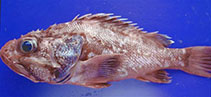
Perciformes/Scorpaenoidei (Scorpionfishes) >
Sebastidae (Rockfishes, rockcods and thornyheads) > Sebastolobinae
Etymology: Trachyscorpia: Greek, trachys, -eia, y = rough + Greek, skorpis, idos = a kind of fish without identification (Ref. 45335).
More on authors: Goode & Bean.
Issue
In almost all references, Trachyscorpia cristulata is mentioned by its subspecies (see ECoF), that we tentatively recognized here at species rank, T.c. cristulata (West Atlantic) and T.c. echinata (East Atlantic) until further work clarify the situation. So, one has to exercise caution with respect to the information that are attached to Trachyscorpia cristulata as a species.
Environment: milieu / climate zone / intervalo de profundidade / distribution range
Ecologia
marinhas demersal; intervalo de profundidade 130 - 1389 m (Ref. 7251). Subtropical; 60°N - 23°N, 98°W - 1°W
Western Atlantic: Massachusetts and northern Gulf of Mexico to southern Florida in USA.
Tamanho / Peso / Idade
Maturidade: Lm ? range ? - ? cm
Max length : 50.0 cm SL macho/indeterminado; (Ref. 75873)
Anterolateral glandular grooves with venom gland (Ref. 57406).
Life cycle and mating behavior
Maturidade | Reprodução | Desova | Ovos | Fecundidade | Larvas
Robins, C.R. and G.C. Ray, 1986. A field guide to Atlantic coast fishes of North America. Houghton Mifflin Company, Boston, U.S.A. 354 p. (Ref. 7251)
Categoria na Lista Vermelha da IUCN (Ref. 130435: Version 2025-1)
Utilização humana
Ferramentas
Relatórios especiais
Descarregue XML
Fontes da internet
Estimates based on models
Preferred temperature (Ref.
123201): 9.4 - 14.6, mean 10.4 °C (based on 65 cells).
Phylogenetic diversity index (Ref.
82804): PD
50 = 0.5078 [Uniqueness, from 0.5 = low to 2.0 = high].
Bayesian length-weight: a=0.00912 (0.00407 - 0.02046), b=3.09 (2.88 - 3.30), in cm total length, based on LWR estimates for this (Sub)family-body shape (Ref.
93245).
Nível Trófico (Ref.
69278): 3.9 ±0.6 se; based on size and trophs of closest relatives
Resiliência (Ref.
120179): Muito baixo, tempo mínimo de duplicação da população maior que 14 anos (Preliminary K or Fecundity.).
Fishing Vulnerability (Ref.
59153): Moderate vulnerability (44 of 100).
🛈
Climate Vulnerability (Ref.
125649): Low to moderate vulnerability (28 of 100).
🛈
Nutrients (Ref.
124155): Calcium = 57.3 [19.4, 152.6] mg/100g; Iron = 1.07 [0.46, 2.22] mg/100g; Protein = 17.9 [16.2, 19.6] %; Omega3 = 0.651 [0.284, 1.689] g/100g; Selenium = 48.4 [21.4, 128.0] μg/100g; VitaminA = 21.9 [7.2, 70.4] μg/100g; Zinc = 0.671 [0.376, 1.057] mg/100g (wet weight);