>
Eupercaria/misc (Various families in series Eupercaria) >
Labridae (Wrasses) > Corinae
Etymology: Macropharyngodon: Greek, makros = great + Greek, pharyngx = pharynx + Greek,odous = teeth (Ref. 45335).
More on author: Herre.
Environment: milieu / climate zone / intervalo de profundidade / distribution range
Ecologia
marinhas associadas(os) a recifes; não migratória; intervalo de profundidade 8 - 32 m (Ref. 1602), usually 8 - 32 m (Ref. 27115). Tropical; 24°C - 28°C (Ref. 27115); 30°N - 24°S
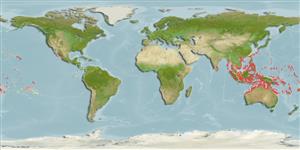
Eastern Indian Ocean and Western Pacific: Andaman Sea (Ref. 9710) and Christmas Island (Ref. 30874) to the Philippines and Samoa, north to Ryukyu Islands, south to northern Australia.
Tamanho / Peso / Idade
Maturidade: Lm ? range ? - ? cm
Max length : 12.0 cm TL macho/indeterminado; (Ref. 9710)
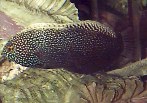
Espinhos dorsais (total) : 9; Raios dorsais moles (total) : 11; Espinhos anais: 3; Raios anais moles: 11; Vértebras: 25. Color in life of black with iridescent blue-green spots on body and light yellow antero-dorsally on head body; head banded. Anterior lateral line pored scales 2-3. Males display with metallic green shiny color that is turned on shortly for the occasion (Ref. 48636).
Body shape (shape guide): fusiform / normal; Cross section: compressed.
Inhabits lagoon and seaward reefs, in areas of mixed sand and coral (Ref. 9710). Post pelagic juveniles carried by currents beyond their normal breeding range. They are often in pairs or small loose groups, swimming close to the bottom. When approached, they move up and down in an unusual way that may worry a possible predator. Adults move about in small groups. (Ref. 48636).
Life cycle and mating behavior
Maturidade | Reprodução | Desova | Ovos | Fecundidade | Larvas
Oviparous, distinct pairing during breeding (Ref. 205).
Randall, J.E., 1978. A revision of the Indo-Pacific labrid fish genus Macropharyngodon, with descriptions of five new species. Bull. Mar. Sci. 28(4):742-770. (Ref. 2694)
Categoria na Lista Vermelha da IUCN (Ref. 130435: Version 2025-1)
Ameaça para o homem
Harmless
Utilização humana
Pescarias: espécies comerciais; Aquário: Espécies comerciais
Ferramentas
Relatórios especiais
Descarregue XML
Fontes da internet
Estimates based on models
Preferred temperature (Ref.
123201): 25.2 - 29, mean 28.1 °C (based on 866 cells).
Phylogenetic diversity index (Ref.
82804): PD
50 = 0.5002 [Uniqueness, from 0.5 = low to 2.0 = high].
Bayesian length-weight: a=0.00977 (0.00466 - 0.02049), b=3.07 (2.90 - 3.24), in cm total length, based on LWR estimates for this (Sub)family-body shape (Ref.
93245).
Nível Trófico (Ref.
69278): 3.5 ±0.4 se; based on size and trophs of closest relatives
Resiliência (Ref.
120179): Elevada, tempo mínimo de duplicação da população menor que 15 meses (Preliminary K or Fecundity.).
Fishing Vulnerability (Ref.
59153): Low vulnerability (10 of 100).
🛈
Nutrients (Ref.
124155): Calcium = 99.8 [59.3, 177.4] mg/100g; Iron = 0.773 [0.445, 1.445] mg/100g; Protein = 18.5 [15.6, 20.7] %; Omega3 = 0.17 [0.11, 0.28] g/100g; Selenium = 22.8 [13.0, 42.4] μg/100g; VitaminA = 158 [48, 611] μg/100g; Zinc = 1.75 [1.17, 2.72] mg/100g (wet weight);