Environment: milieu / climate zone / intervalo de profundidade / distribution range
Ecologia
marinhas demersal; intervalo de profundidade 6 - 55 m (Ref. 48238). Tropical
Distribuição
Países | Áreas FAO | Ecossistemas | Ocorrências | Mapa dos pontos | Introduções | Faunafri
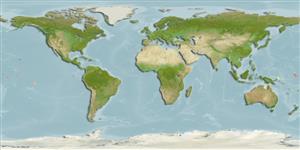
Eastern Central Pacific: Kiribati. Appears to be endemic to this part of the Pacific.
Tamanho / Peso / Idade
Maturidade: Lm ? range ? - ? cm
Max length : 21.2 cm SL macho/indeterminado; (Ref. 48238); 14.3 cm SL (female)
Descrição breve
Chaves de identificação | Morfologia | Morfometria
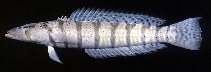
Espinhos dorsais (total) : 5; Raios dorsais moles (total) : 21; Espinhos anais: 1; Raios anais moles: 17; Vértebras: 30. Predorsal scales about 15. Small and cycloid scales on cheek; on body ctenoid. No serrae or spines on edges of opercular bones except a single stout spine on opercle. Body elongate, depth 5.7-6.2 in SL; whitish with 8 narrow dark bars, all but first and last broadly expanded dorsally to a Y-shape. Body cylindrical anteriorly, the width slightly greater than depth. Third or 4th dorsal spines longest; membrane of 5th dorsal spine connected directly across from spine tip to first soft ray. Caudal fin slightly rounded, upper corner projecting as a short, broad-based filament in adults. Mouth slightly oblique, the lower jaw projecting.
Body shape (shape guide): elongated; Cross section: oval.
Collected from sand or sand and rubble substrata in both lagoon and seaward reef areas. Large and easily approached. Apparently a protogynous hermaphrodite (Ref. 48238).
Life cycle and mating behavior
Maturidade | Reprodução | Desova | Ovos | Fecundidade | Larvas
Randall, J.E. and J.E. McCosker, 2002. Parapercis lata, a new species of sandperch (Perciformes: Pinguipedidae) from the central Pacific. Proc. Calif. Acad. Sci. 53(8):87-93. (Ref. 48238)
Categoria na Lista Vermelha da IUCN (Ref. 130435: Version 2025-1)
Ameaça para o homem
Harmless
Utilização humana
Ferramentas
Relatórios especiais
Descarregue XML
Fontes da internet
Estimates based on models
Preferred temperature (Ref.
123201): 26.2 - 28.5, mean 27.2 °C (based on 32 cells).
Phylogenetic diversity index (Ref.
82804): PD
50 = 0.5000 [Uniqueness, from 0.5 = low to 2.0 = high].
Bayesian length-weight: a=0.00692 (0.00314 - 0.01524), b=3.06 (2.88 - 3.24), in cm total length, based on LWR estimates for this Genus-body shape (Ref.
93245).
Nível Trófico (Ref.
69278): 3.6 ±0.4 se; based on size and trophs of closest relatives
Resiliência (Ref.
120179): Médio, tempo mínimo de duplicação da população 1,4 - 4,4 anos (Preliminary K or Fecundity.).
Fishing Vulnerability (Ref.
59153): Low vulnerability (16 of 100).
🛈
Nutrients (Ref.
124155): Calcium = 221 [137, 384] mg/100g; Iron = 1.18 [0.74, 1.86] mg/100g; Protein = 17.3 [15.2, 19.1] %; Omega3 = 0.162 [0.090, 0.283] g/100g; Selenium = 50.1 [26.4, 94.8] μg/100g; VitaminA = 27.7 [10.2, 71.3] μg/100g; Zinc = 1.45 [1.06, 1.98] mg/100g (wet weight);