>
Perciformes/Scorpaenoidei (Scorpionfishes) >
Triglidae (Searobins) > Triglinae
Etymology: Lepidotrigla: Greek, lepis, lepidos = scale + Greek, trigla, es = red mullet (Ref. 45335); psolokerkos: Name fro Greek 'psolos' for 'dirt' and 'kerkos' for 'tail', referring to the distinctive grey blotch dorsoposteriorly on the caudal fin of this species.
Environment: milieu / climate zone / rango de profundidad / distribution range
Ecología
marino demersal; rango de profundidad 151 - 255 m (Ref. 118062). Tropical
Eastern Indian Ocean: Andaman Sea, off SE Myanmar.
Tamaño / Peso / Age
Madurez: Lm ? range ? - ? cm
Max length : 14.2 cm SL macho / no sexado; (Ref. 118062)
Short description
Claves de identificación | Morfología | Morfometría
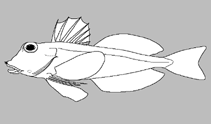
Espinas dorsales (total) : 9; Radios blandos dorsales (total) : 16; Radios blandos anales: 15 - 17; Vértebra: 32 - 33. This species is distinguished by the following characters: lateral profile of body with straight taper to slender caudal peduncle; distinct postorbital notch above and behind each eye but not extending across top of head as occipital groove; rostral process with a broad medial notch edged with small spines becoming progressively longer to corner on each side when viewed from above; pored lateral line scales 61-62; scales below lateral line about 15 or 16; D1 IX, D2 16; A 15-17; pectoral fins reaching to about fourth anal fin ray. Colouration: upper two-thirds of caudal fin broadly grey distally, red below; inner surface of pectoral fin mostly black with red margin basally, ventrally and along narrow outer edge (Ref. 118062).
Cross section: angular.
Life cycle and mating behavior
Madurez | Reproducción | Puesta | Huevos | Fecundidad | Larva
Gomon, M.F. and P.N. Psomadakis, 2018. Review of the Lepidotrigla gurnards (Teleostei: Scorpaeniformes: Triglidae) in the Bay of Bengal and Andaman Sea off Myanmar with a description of a new species. Raffles Bull. Zool. 66:66-77. (Ref. 118062)
IUCN Red List Status (Ref. 130435: Version 2025-1)
Threat to humans
Harmless
Human uses
Pesquerías: sin interés
Herramientas
Special reports
Download XML
Fuentes de Internet
Estimates based on models
Phylogenetic diversity index (Referencia
82804): PD
50 = 0.5000 [Uniqueness, from 0.5 = low to 2.0 = high].
Bayesian length-weight: a=0.00676 (0.00325 - 0.01404), b=3.05 (2.87 - 3.23), in cm total length, based on LWR estimates for this (Sub)family-body shape (Ref.
93245).
Nivel trófico (Referencia
69278): 3.4 ±0.3 se; based on size and trophs of closest relatives
Resiliencia (Referencia
120179): Alto, población duplicada en un tiempo mínimo inferior a 15 meses (Preliminary K or Fecundity.).
Fishing Vulnerability (Ref.
59153): Low vulnerability (10 of 100).
🛈