>
Perciformes/Scorpaenoidei (Scorpionfishes) >
Triglidae (Searobins) > Triglinae
Etymology: Lepidotrigla: Greek, lepis, lepidos = scale + Greek, trigla, es = red mullet (Ref. 45335); maculapinna: Name from Latin 'macula' meaning spot and 'pinna' for wing; referring to the distinctive dark edged pale blue spots on the inner surface of the pectoral fin that are a characteristic of this species.
Environment: milieu / climate zone / intervalo de profundidade / distribution range
Ecologia
marinhas demersal; intervalo de profundidade 100 - 280 m (Ref. 127946). Tropical
Eastern Indian Ocean: Indonesia.
Tamanho / Peso / Idade
Maturidade: Lm ? range ? - ? cm
Max length : 10.2 cm SL macho/indeterminado; (Ref. 127946)
Descrição breve
Chaves de identificação | Morfologia | Morfometria
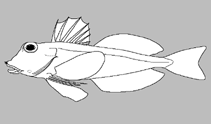
Espinhos dorsais (total) : 8 - 9; Raios dorsais moles (total) : 15 - 16; Raios anais moles: 15; Vértebras: 30 - 31. This species can be distinguished from by the following characters: lateral profile of body with slight convex curve from posterior part of first dorsal fin base to moderately narrow caudal peduncle; with a narrow postorbital notch above and behind each eye, no furrow across nape at rear of interorbital space; rostral process with a broad angular notch having few if any tiny spine tips jutting anteriorly from smooth rostral edge, moderately large triangular spine at apical corner; pored lateral line scales 58-59; scales above lateral line 2 and below about 16 scales; D1 VIII-IX, with first spine slightly shorter than subequal second and third, subsequent spines progressively shorter, D2 15-16; A 15; pectoral fins reaching about fourth or fifth anal fin ray, the first free pectoral fin ray not quite reaching tip of interconnected portion of fin above, extending just to tip of pelvic fin, length of first free ray about equal to length of pectoral fin. Colouration: caudal fin white with broad, red sub distal band and reddish base; inner surface of the pectoral fin blackish with two transverse rows of large darkly ocellated milky blue spots, thin pink distal edge and broad yellow lower margin (Ref. 127939)
Cross section: compressed.
Life cycle and mating behavior
Maturidade | Reprodução | Desova | Ovos | Fecundidade | Larvas
Gomon, M.F. and T. Kawai, 2018. A review of Indonesia’s Indian Ocean species of Lepidotrigla gurnards (Teleostei: Scorpaeniformes: Triglidae) with descriptions of three new species from southern coastal waters. Raffles Bull. Zool. 66:624-651. (Ref. 127946)
Categoria na Lista Vermelha da IUCN (Ref. 130435: Version 2025-1)
Ameaça para o homem
Harmless
Utilização humana
Pescarias: sem interesse
Ferramentas
Relatórios especiais
Descarregue XML
Fontes da internet
Estimates based on models
Phylogenetic diversity index (Ref.
82804): PD
50 = 0.5000 [Uniqueness, from 0.5 = low to 2.0 = high].
Bayesian length-weight: a=0.00912 (0.00427 - 0.01947), b=3.05 (2.87 - 3.23), in cm total length, based on LWR estimates for this (Sub)family-body shape (Ref.
93245).
Nível Trófico (Ref.
69278): 3.4 ±0.3 se; based on size and trophs of closest relatives
Resiliência (Ref.
120179): Elevada, tempo mínimo de duplicação da população menor que 15 meses (Preliminary K or Fecundity.).
Fishing Vulnerability (Ref.
59153): Low vulnerability (10 of 100).
🛈