



Alectrias markevichi Sheiko, 2012
Adicionar o seu Fotografias e vídeos
Imagem do Google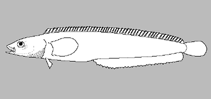 No image available for this species;
drawing shows typical species in Stichaeidae.
Imagem do Google
drawing shows typical species in Stichaeidae.
Classificação / Nomes Nomes comuns | Sinónimos | Catalog of Fishes(Género, Espécies) | ITIS | CoL | WoRMS | Cloffa
> Perciformes/Zoarcoidei (Eelpouts and pricklebacks) > Stichaeidae (Pricklebacks) > Alectriinae
Etymology: Alectrias: Greek, alektros, -os, -on = single, married in illegal or unhappy marriage (Ref. 45335); markevichi: Named for Aleksandr Igorevich Markevich, worker of the Far Eastern Marine Biosphere Reserve, Far Eastern Branch, Russian Academy of Sciences (Vladivostok).
Eponymy: Aleksandr Igorevich Markevich is a worker at the Far Eastern Marine Biosphere Reserve, Russian Academy of Sciences (Vladivostok). The author gives no further biography. (Ref. 128868), visit book page.
Etymology: Alectrias: Greek, alektros, -os, -on = single, married in illegal or unhappy marriage (Ref. 45335); markevichi: Named for Aleksandr Igorevich Markevich, worker of the Far Eastern Marine Biosphere Reserve, Far Eastern Branch, Russian Academy of Sciences (Vladivostok).
Eponymy: Aleksandr Igorevich Markevich is a worker at the Far Eastern Marine Biosphere Reserve, Russian Academy of Sciences (Vladivostok). The author gives no further biography. (Ref. 128868), visit book page.
Ambiente: milieu / zona climática / intervalo de profundidade / gama de distribuição Ecologia
marinhas pelagic-neritic; intervalo de profundidade 0 - 50 m (Ref. 91064), usually 30 - 50 m (Ref. 91064). Temperate
Distribuição Territórios | Áreas FAO | Ecossistemas | Ocorrências | Mapa dos pontos | Introduções | Faunafri
Northwest Pacific: Japan, Peter the Great Bay and Moneron Island (the Sea of Japan), South Kuril Strait.
Tamanho / Peso / Idade
Descrição breve Chaves de identificação | Morfologia | Morfometria
Raios dorsais moles (total) : 62 - 63; Raios anais moles: 43 - 44; Vértebras: 66 - 68. This species is distinguished by the following characters: thin and elongated body, its depth 10.2-14.1 (12.9) times in SL; small head, 6.6-8.0 (7.2) times in SL; small pectoral and caudal fins, 2.5-4.0 (3.0) and 1.9-2.7 (2.2) times HL, respectively; occipital commissure with 3 pores almost at the straight line; no pores near crest base and no medial tubule; postorbital canal usually with 6 pores (usually pore po2 is absent); preopercular canal with 4 pores; skinny crest on head with a smooth upper profile - in females, it is highest in the middle, while in males, it is highest near the posterior margin; distance between the anterior margin of medial pore of OC and origin of D is large, 0..5-9 (0.7) times in horizontal orbit diameter; scales present behind 2nd-8th ray of anal fin; D 62-63. P 7-9. V. 66-68; 13-16 spines of dorsal fin are thin and bending, at its end, there is only one shortened spine; anal fin begins under the 19th-21st ray of dorsal fin, its last ray is connected by a membrane with caudal fin 75-90 (85.4)% of its length; caudal fin with 8-11 branched rays; no branched rays on epural3; preural vertebrae with wide neural processes 11-18, and those with hemapophyseal plate 9-12; vertebrae with hemapophyseal plate, neural processes are noticeably shorter than hemal ones; top of head covered with small brown spots (Ref. 91064).
Body shape (shape guide): elongated; Cross section: compressed.
Body shape (shape guide): elongated; Cross section: compressed.
Found on rocky littoral formed of slightly flattened stones, 30-60 cm, with narrow slits that are partially filled with sand, gravel ad small stones. Stomachs contain small gastropods (Ref. 91064).
Ciclo de vida e comportamento de acasalamento Maturidade | Reprodução | Desova | Ovos | Fecundidade | Larvas
Referência principal
Carregar as suas referências | Referências | Coordenador | Colaboradores
Sheiko, B.A., 2012. Alectrias markevichi sp. nov. - A new species of cockscombs (Perciformes: Stichaeidae: Alectriinae) from the sublittoral of the sea of Japan and adjacent waters. J. Ichthyo. 52(5):308-320. (Ref. 91064)
CITES
Not Evaluated
Ameaça para o homem
Harmless
Utilização humana
FAO - Publication: search | FishSource |
Mais informação
Ecologia Trófica
Produtos alimentares (presas)
Composição da dieta
Consumo alimentar
Rações alimentares
Predadores
Produtos alimentares (presas)
Composição da dieta
Consumo alimentar
Rações alimentares
Predadores
Ecologia
Ecologia
Ecologia
Dinâmica das populações
Parâmetros de crescimento
Idades / tamanhos máximos
Comprimento-peso rel.
Comprimento-comprimento rel.
Frequência de comprimento
Conversão de massa
Recrutamento
Abundância
Parâmetros de crescimento
Idades / tamanhos máximos
Comprimento-peso rel.
Comprimento-comprimento rel.
Frequência de comprimento
Conversão de massa
Recrutamento
Abundância
Ciclo de vida
Reprodução
Maturidade
Maturidade/Rel. das guelras
Fecundidade
Desova
Agregações de desova
Ovos
Desenvolvimento dos ovos
Larvas
Dinâmica larvar
Reprodução
Maturidade
Maturidade/Rel. das guelras
Fecundidade
Desova
Agregações de desova
Ovos
Desenvolvimento dos ovos
Larvas
Dinâmica larvar
Anatomia
Área branquial
Cérebro
Otólitos
Área branquial
Cérebro
Otólitos
Fisiologia
Composição corporal
Nutrientes
Consumo de oxigénio
Tipo de natação
Velocidade de natação
Pigmentos visuais
Som de peixe
Doenças e Parasitas
Toxicidade (LC50s)
Composição corporal
Nutrientes
Consumo de oxigénio
Tipo de natação
Velocidade de natação
Pigmentos visuais
Som de peixe
Doenças e Parasitas
Toxicidade (LC50s)
Genética
genoma
Genética
Heterozigotia
Hereditariedade
Diversidade genética
genoma
Genética
Heterozigotia
Hereditariedade
Diversidade genética
Relacionado com o ser humano
Sistemas de aquacultura
Perfis para aquacultura
Estirpes
Casos de Ciguatera
Selos, moedas, diversos.
Sistemas de aquacultura
Perfis para aquacultura
Estirpes
Casos de Ciguatera
Selos, moedas, diversos.
Ferramentas
E-book | Guia de campo | Ferramenta auxiliar de frequências de comprimento | Ferramenta sobre a história de vida | Mapa dos pontos |
Captura-MSY |
Relatórios especiais
Descarregue XML
Fontes da internet
AFORO (otoliths) | Aquatic Commons | BHL | Cloffa | Websites from users | Consultar FishWatcher | CISTI | Catalog of Fishes: Género, Espécies | DiscoverLife | ECOTOX | FAO - Publication: search | Faunafri | Fishipedia | Fishtrace | GloBI | Google Books | Google Scholar | Google | IGFA World Record | OneZoom | Open Tree of Life | Otolith Atlas of Taiwan Fishes | PubMed | Reef Life Survey | Socotra Atlas | TreeBase | Árvore da vida | Wikipedia: ir para, procurar | World Records Freshwater Fishing | Zoobank | Registo zoológico
Estimativas baseadas em modelos
Índice de diversidade filogenética (Ref. 82804): PD50 = 0.5156 [Uniqueness, from 0.5 = low to 2.0 = high].
Bayesian length-weight: a=0.00389 (0.00180 - 0.00842), b=3.12 (2.94 - 3.30), in cm total length, based on all LWR estimates for this body shape (Ref. 93245).
Nível Trófico (Ref. 69278): 3.1 ±0.4 se; based on size and trophs of closest relatives
Resiliência (Ref. 120179): Elevada, tempo mínimo de duplicação da população menor que 15 meses (Preliminary K or Fecundity.).