Elasmobranchii (tubarões e raias) (sharks and rays) >
Rajiformes (Skates and rays) >
Rajidae (Skates)
Etymology: Dipturus: Greek, di = two + Greek, pteryx = fin (Ref. 45335); wuhanlingi: Named for Han-Lin Wu, Shanghai Fisheries University for his contributions to the ichthyology of China.
Eponymy: Dr Wu Han-Lin is a Professor of Ichthyology at Shanghai Ocean University and Director of the Fisheries Laboratory (2012), having previously been at Shanghai Fisheries University (2000). [...] (Ref. 128868), visit book page.
Environment: milieu / climate zone / intervalo de profundidade / distribution range
Ecologia
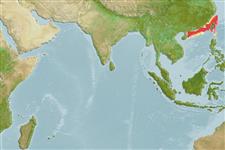
marinhas bentopelágico; intervalo de profundidade ? - 200 m (Ref. 114953). Subtropical; 28°N - 18°N, 111°E - 123°E (Ref. 114953)
Northwest Pacific: South and East China Seas (China) (Ref. 114953).
Tamanho / Peso / Idade
Maturidade: Lm ? range ? - ? cm
Max length : 66.8 cm TL macho/indeterminado; (Ref. 75712); 78.4 cm TL (female)
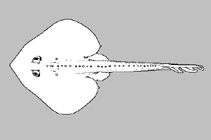
Tip of pectoral girdle propterygium well separated from rostral node by about a half of rostral cartilage length. Preorbital snout long, 20% (holotype) and 21% (paratype) TL; rostral shaft straight, wide and stout; anterior fontanelle with distinct anterior margin. A single
scapular thorn on each side; three or four nuchal thorns; a row of lumbar thorns along dorsal midline of disc. Tail thin, narrow, slightly depressed, its length short as 45% (holotype) and 43% (paratype) TL; a single row of distinct thorns along dorsal midline in both sexes. Scapulocoracoid without anterior bridge; anterior fenestra strongly anteroposteriorly elliptical; postventral fenestra expanded horizontally; mesocondyle located at about middle between
procondyle and metacondyle. Pelvic girdle with three pairs of obturator foramina. Pores of ampullae of Lorenzini extending to just before pelvic girdle. Clasper glans with cleft, terminal bridge, shield and rhipidion; dermal denticles
absent. Tooth rows 36 (holotype) and 32 (paratype) in upper jaw. Trunk vertebrae 27; predorsal caudal vertebrae 47. Pectoral radials 92 on each side (Ref. 75712).
Body shape (shape guide): other; Cross section: flattened.
A demersal species with unknown capture depth, probably continental slope below 200 m. Occasionally found at regional fish markets with few retained by museums (Ref. 114953).
Life cycle and mating behavior
Maturidade | Reprodução | Desova | Ovos | Fecundidade | Larvas
Jeong, C.-H. and T. Nakabo, 2008. Dipturus wuhanlingi, a new species of skates (Elasmobranchii: Rajidae) from China inland. Ichthyol. Res. 55:183-190. (Ref. 75712)
Categoria na Lista Vermelha da IUCN (Ref. 130435: Version 2025-1)
Ameaça para o homem
Harmless
Utilização humana
Ferramentas
Relatórios especiais
Descarregue XML
Fontes da internet
Estimates based on models
Preferred temperature (Ref.
123201): 9.6 - 19.5, mean 14.3 °C (based on 38 cells).
Phylogenetic diversity index (Ref.
82804): PD
50 = 0.5000 [Uniqueness, from 0.5 = low to 2.0 = high].
Bayesian length-weight: a=0.00282 (0.00131 - 0.00604), b=3.25 (3.08 - 3.42), in cm total length, based on LWR estimates for this Genus-body shape (Ref.
93245).
Nível Trófico (Ref.
69278): 3.8 ±0.6 se; based on size and trophs of closest relatives
Resiliência (Ref.
120179): Baixo, tempo mínimo de duplicação da população 4,5 - 14 anos (Preliminary low fecundity).
Fishing Vulnerability (Ref.
59153): Moderate to high vulnerability (51 of 100).
🛈