



Etmopterus benchleyi Vásquez, Ebert & Long, 2015
Ninja lanternshark
Adicionar sua observação em Fish Watcher
| Native range | All suitable habitat | Point map | Year 2050 |

|
| This map was computer-generated and has not yet been reviewed. |
| Etmopterus benchleyi AquaMaps Data sources: GBIF OBIS |
Carregue seu(sua) Fotos e vídeos
Imagem do Google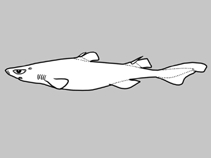 No image available for this species;
drawing shows typical species in Etmopteridae.
Imagem do Google
drawing shows typical species in Etmopteridae.
Classificação / Nomes Nomes comuns | Sinônimos | Catalog of Fishes(Gênero, Espécies) | ITIS | CoL | WoRMS | Cloffa
Elasmobranchii (tubarões e raias) (sharks and rays) > Squaliformes (Sleeper and dogfish sharks) > Etmopteridae (Lantern sharks)
Etymology: Etmopterus: Greek, ethmos, -ou = sieve or ethmoides bone + Greek, pteron = wing, fin (Ref. 45335); benchleyi: Named for Peter Benchley, author of the movie Jaws and subsequently an avid shark conservationist.
Eponymy: Peter Benchley (1940–2006) was an American author and screenwriter, best known for writing Jaws (1974). [...] (Ref. 128868), visit book page.
Etymology: Etmopterus: Greek, ethmos, -ou = sieve or ethmoides bone + Greek, pteron = wing, fin (Ref. 45335); benchleyi: Named for Peter Benchley, author of the movie Jaws and subsequently an avid shark conservationist.
Eponymy: Peter Benchley (1940–2006) was an American author and screenwriter, best known for writing Jaws (1974). [...] (Ref. 128868), visit book page.
Meio ambiente: milieu / Zona climática / intervalo de profundidade / faixa de distribuição Ecologia
marinhas pelagic-oceanic; intervalo de profundidade 836 - 1443 m (Ref. 106129). Deep-water; 13°N - 6°N, 89°W - 80°W (Ref. 106129)
Distribuição Territórios | Áreas da FAO | Ecossistemas | Ocorrências | Mapa de pontos | Introduções | Faunafri
Eastern Pacific Ocean: from Nicaragua south to Panama.
Tamanho / Peso / Idade
Maturidade: Lm ? range ? - ? cm
Max length : 32.5 cm TL macho/indeterminado; (Ref. 106129); 51.5 cm TL (female)
Max length : 32.5 cm TL macho/indeterminado; (Ref. 106129); 51.5 cm TL (female)
Descrição suscinta Chaves de identificação | Morfologia | Morfometria
This moderately large species is distinguished by the following set of characters: short snout with pre-narial length 2.9% TL (2.9-4.0%) and pre-oral length 7.8% TL (6.9-9.0%); broad mouth strongly arched, width 1.2 (1.0-1.5) times into pre-oral length; dentition show strong disjunct dignathic heterodonty with upper teeth comprised of single median cusp, flanked by 1-2 pairs of lateral cusplets, where lower teeth with low, distally-inclined cusps lacking serrations and a low posterior blade; dermal denticles are short, slender, with slightly hook-like conical crowns; denticles below second dorsal fin in irregular patch densities and align into rows along the ceratotrichia of the fins; denticles dense around the eyes and gill openings, sparse to bare on ventrum of snout tip and around mouth; first and dorsal fins similar in size; the second-dorsal-fin spine 1.7 (1.6-2.3) times longer than first-dorsal-fin spine; the second-dorsal-fin spine height greater than second-dorsal-fin apex; interdorsal-fin space is moderately long, 23.1% TL (19.2-21.4%); body color uniformly black, the anteroposteriorly oblong narrow pineal window apparent (Ref. 106129)
Body shape (shape guide): elongated; Cross section: angular.
Body shape (shape guide): elongated; Cross section: angular.
The larger individuals of this species were collected at greater depth than smaller specimens, suggesting a positive relationship between size and depth, as has been observed in E. princeps. The largest paratype (51.5 cm TL) contains five ova ranging from 25.6 to 34.2 mm, with no embryos apparent. The immature male paratype has claspers at the earliest stage of development, suggesting that maturity for males is attained at a greater size. Viviparous with litter sizes apparently consist of at least 5 pups with post-partum lengths less than 177 mm TL (Ref. 106129).
Ciclo de vida ou comportamento de acasalamento Maturidade | Reprodução | Desova | Ovos | Fecundidade | Larvas
Referência principal
Carregar suas referências | Referências | Coordenador | Colaboradores
Vásquez, V.E., Ebert. D.A. and D.J. Long, 2015. Etmopterus benchleyi n. sp., a new lanternshark (Squaliformes: Etmopteridae) from the central eastern Pacific Ocean. J. Ocean Sci. Found. 17:43-55. (Ref. 106129)
Status na Lista Vermelha da UICN (Ref. 130435: Version 2025-2 (Global))
Segura ou pouco preocupante (LC) ; Date assessed: 08 February 2019
CITES
Not Evaluated
Ameaça para os humanos
Harmless
Uso pelos humanos
Pescarias: sem interesse
FAO - Publication: search | FishSource |
Mais informação
Ecologia Trófica
Itens alimentares (presas)
Composição da dieta
Consumo alimentar
Rações alimentares
Predadores
Itens alimentares (presas)
Composição da dieta
Consumo alimentar
Rações alimentares
Predadores
Ecologia
Ecologia
Ecologia
Dinâmica populacional
Parâmetros de crescimento
Idade máxima / tamanhos
Relação comprimento-peso.
Relação comprimento-comprimento.
Frequências de comprimento
Conversão de massa
Recrutamento
Abundância
Parâmetros de crescimento
Idade máxima / tamanhos
Relação comprimento-peso.
Relação comprimento-comprimento.
Frequências de comprimento
Conversão de massa
Recrutamento
Abundância
Ciclo de vida
Reprodução
Maturidade
Maturidade/Rel. das guelras
Fecundidade
Desova
Agregações de desova
Ovos
Desenvolvimento dos ovos
Larvas
Dinâmica larval
Reprodução
Maturidade
Maturidade/Rel. das guelras
Fecundidade
Desova
Agregações de desova
Ovos
Desenvolvimento dos ovos
Larvas
Dinâmica larval
Anatomia
Área branquial
Cérebro
Otólito
Área branquial
Cérebro
Otólito
Fisiologia
Composição corporal
Nutrientes
Consumo de oxigênio
Tipo de natação
Velocidade de natação
Pigmentos visuais
Som de peixe
Doenças e Parasitas
Toxicidade (LC50s)
Composição corporal
Nutrientes
Consumo de oxigênio
Tipo de natação
Velocidade de natação
Pigmentos visuais
Som de peixe
Doenças e Parasitas
Toxicidade (LC50s)
Genética
genoma
Genética
Heterozigosidade
Hereditariedade
Diversidade genética
genoma
Genética
Heterozigosidade
Hereditariedade
Diversidade genética
Relacionado a humanos
Sistemas de aquicultura
Perfis para aquacultura
Estirpes
Casos de Ciguatera
Selos, moedas, diversos.
Sistemas de aquicultura
Perfis para aquacultura
Estirpes
Casos de Ciguatera
Selos, moedas, diversos.
Ferramentas
Livro eletrônico | Guia de campo | Ferramenta auxiliar de frequências de comprimento | Ferramenta sobre a história de vida | Mapa de pontos |
Catch-MSY |
Relatórios especiais
Checar Manutenção em Aquário | Checar Planilhas de Fatos sobre as Espécies | Checar Planilhas de Fatos sobre Aquicultura
Baixar XML
Fontes da internet
AFORO (otoliths) | Aquatic Commons | BHL | Cloffa | Websites from users | Checar Observador de Peixes (FishWatcher) | CISTI | Catalog of Fishes: Gênero, Espécies | DiscoverLife | ECOTOX | FAO - Publication: search | Faunafri | Fishipedia | Fishtrace | GloBI | Google Books | Google Scholar | Google | IGFA World Record | OneZoom | Open Tree of Life | Otolith Atlas of Taiwan Fishes | PubMed | Reef Life Survey | Socotra Atlas | TreeBase | Árvore da vida | Wikipedia: Ir para, procura | World Records Freshwater Fishing | Zoobank | Registro zoológico
Estimativas baseadas em modelos
Temperatura preferida (Ref. 123201): 3.3 - 3.5, mean 3.4 °C (based on 6 cells).
Índice de diversidade filogenética (Ref. 82804): PD50 = 0.5000 [Uniqueness, from 0.5 = low to 2.0 = high].
Bayesian length-weight: a=0.00389 (0.00200 - 0.00755), b=3.08 (2.91 - 3.25), in cm total length, based on LWR estimates for this Genus-body shape (Ref. 93245).
Nível Trófico (Ref. 69278): 4.2 ±0.6 se; based on size and trophs of closest relatives
Resiliência (Ref. 120179): Baixo, tempo mínimo de duplicação da população 4,5 - 14 anos (Preliminary K or Fecundity.).