>
Osteoglossiformes (Bony tongues) >
Mormyridae (Elephantfishes)
Etymology: Petrocephalus: Latin, petra = stone + Greek, kephale = head (Ref. 45335).
Eponymy: Dr Cuthbert Christy (1863–1932) was a physician and zoologist who was particularly known for his work on sleeping sickness. [...] (Ref. 128868), visit book page.
More on author: Boulenger.
Environment: milieu / Zona climática / intervalo de profundidade / distribution range
Ecologia
; Água doce demersal; pH range: 5.0 - ?. Tropical; 22°C - 24°C (Ref. 12468)
Africa: widespread in the Congo River basin, from the rapids just below Pool Malebo (Ref. 85331) to the upper Lualaba (Ref. 45616), in Central African Republic (Ref. 113655), Republic of Congo (Ref. 85331), Democratic Republic of the Congo (Ref. 4910, 41585, 45441, 106245, 106290) and Angola (Ref. 11970, 120641).
Tamanho / Peso / Idade
Maturidade: Lm ? range ? - ? cm
Max length : 7.7 cm TL macho/indeterminado; (Ref. 11970)
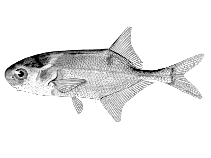
Raios dorsais (total) : 24; Raios anais : 28 - 29. Petrocephalus christyi is distinguished from all other Petrocephalus species in Central Africa by the following combination of characteristics: dorsal fin with 22-24 branched rays, anal fin with 25-29 branched rays, eye large (HL/ED=3,1-4,2), mouth small, 9-13 teeth in the upper jaw, 17-22 teeth in the lower jaw (Ref. 85331). Melanin pattern consisting of two characteristic black patches: (1) a distinct round mark below the anterior base (first to the fifth rays) of the dorsal fin; and (2) a somewhat diffuse crescent-like mark, centered at the base of the caudal fin and extending onto the fleshy dorsal and ventral lobes of this fin (Ref. 85331).
Body shape (shape guide): fusiform / normal.
Ciclo de vida ou comportamento de acasalamento
Maturidade | Reprodução | Desova | Ovos | Fecundidade | Larvas
Gosse, J.-P., 1984. Mormyridae. p. 63-122. In J. Daget, J.-P. Gosse and D.F.E. Thys van den Audenaerde (eds.) Check-list of the freshwater fishes of Africa (CLOFFA). ORSTOM, Paris and MRAC, Tervuren. Vol. 1. (Ref. 3203)
Status na Lista Vermelha da UICN (Ref. 130435: Version 2025-1)
Ameaça para os humanos
Harmless
Uso pelos humanos
Ferramentas
Relatórios especiais
Baixar XML
Fontes da internet
Estimates based on models
Índice de diversidade filogenética (Ref.
82804): PD
50 = 0.5000 [Uniqueness, from 0.5 = low to 2.0 = high].
Bayesian length-weight: a=0.01549 (0.00838 - 0.02861), b=2.88 (2.72 - 3.04), in cm total length, based on LWR estimates for this species & Genus-body shape (Ref.
93245).
Nível Trófico (Ref.
69278): 3.2 ±0.4 se; based on size and trophs of closest relatives
Resiliência (Ref.
120179): Elevada, tempo mínimo de duplicação da população menor que 15 meses (Preliminary K or Fecundity.).
Fishing Vulnerability (Ref.
59153): Low vulnerability (10 of 100).
🛈