分类 / Names
俗名 | 同种异名 | Catalog of Fishes(属, 种) | ITIS | CoL | WoRMS | Cloffa
Teleostei >
Ophidiiformes (Cusk eels) >
Carapidae (Pearlfishes) > Hypopleuroninae
Etymology: Hypopleuron: Greek, hypo = under + greek ,pleura = in the side of (Ref. 45335).
More on authors: Smith & Radcliffe.
Issue
Previously in Ophidiidae, Neobythitinae. Changed in 2024 by Wong et al. (2024; Ref. 133041).
Environment: milieu / climate zone / 深度上下限 / distribution range
生态学
海洋 深海底的; 深度上下限 300 - 575 m (Ref. 34024). 深水域
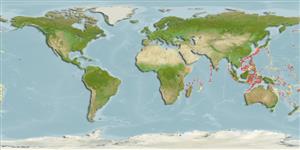
Indo-West Pacific: Arabian Sea, Andaman Sea and the Philippines.
印度-西太平洋: 阿拉伯海,安達曼海與菲律賓。
大小 / 重量 / 年龄
成熟度: Lm ? range ? - ? cm
Max length : 57.0 cm SL 雄鱼/尚未辨别雌雄; (Ref. 34024)
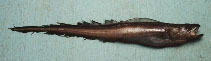
Jaws equal in length or lower jaw slightly protruding; no spines on opercle or subopercle; a canine tooth at the front of each upper jaw bone; median basibranchial tooth patch 1; branchiostegal rays 8; lateral line with small scales that overlie an inner series of larger scales that bear neuromasts; precaudal centra 22, parapophyses broad and inflated, inclosing the swim bladder (Ref. 34024).
Body shape (shape guide): eel-like.
颚长度相等或下颌些微地伸出; 没有在鳃盖或子鳃盖上的棘; 在每个上颌硬骨的前面的一个犬齿; 中动脉基鳃骨齿列 1; 鳃条骨 8; 侧线有躺在有神经瘤的一个内部的成列较大的鳞片上的小鳞片; 尾前椎中心 22, 椎体横突宽的而且使,膨胀围起来泳鳔.(参考文献 34024)
A benthic species found on the continental slope (Ref. 75154). Common species (Ref. 34024). Oviparous, with oval pelagic eggs floating in a gelatinous mass (Ref. 205).
普遍的种.(参考文献 34024)
Life cycle and mating behavior
成熟度 | 繁殖 | 产卵场 | 卵 | 孕卵数 | 仔鱼
印度-西太平洋: 阿拉伯海,安達曼海與菲律賓。
Nielsen, J.G., D.M. Cohen, D.F. Markle and C.R. Robins, 1999. Ophidiiform fishes of the world (Order Ophidiiformes). An annotated and illustrated catalogue of pearlfishes, cusk-eels, brotulas and other ophidiiform fishes known to date. FAO Fish. Synop. 125(18):178p. Rome: FAO. (Ref. 34024)
世界自然保护联盟红皮书 (Ref. 130435: Version 2025-1)
人类利用
渔业: 没有兴趣
工具
特别资料
下载 XML
网络资源
Estimates based on models
Preferred temperature (参考文献
123201): 6.6 - 12.9, mean 10.2 °C (based on 176 cells).
Phylogenetic diversity index (参考文献
82804): PD
50 = 1.0000 [Uniqueness, from 0.5 = low to 2.0 = high].
Bayesian length-weight: a=0.00110 (0.00040 - 0.00297), b=3.08 (2.85 - 3.31), in cm total length, based on LWR estimates for this (Sub)family-body shape (Ref.
93245).
营养阶层 (参考文献
69278): 3.9 ±0.6 se; based on size and trophs of closest relatives
Fishing Vulnerability (Ref.
59153): Moderate to high vulnerability (48 of 100).
🛈