>
Gonorynchiformes (Milkfishes) >
Kneriidae (Shellears)
Etymology: Kneria: From Kner, that studied fishes in the Imperial Museum of Vienna, with Jean Natterer (1817) (Ref. 45335).
Eponymy: Dr Rudolf Kner (1810–1869) was an Austrian zoologist specialising in ichthyology. [...] This is a toponym; the holoypes of these fishes were collected in Katanga Province (formerly part of the Belgian Congo, now the Democratic Republic of Congo). (Ref. 128868), visit book page.
More on author: Poll.
Environment: milieu / Zona climática / intervalo de profundidade / distribution range
Ecologia
; Água doce bentopelágico. Tropical
Africa: Munte River system (Lufira River tributary, upper Lualaba drainage) in Democratic Republic of the Congo (Ref. 2970, 45434).
Tamanho / Peso / Idade
Maturidade: Lm ? range ? - ? cm
Max length : 4.8 cm SL macho/indeterminado; (Ref. 2970)
Descrição suscinta
Chaves de identificação | Morfologia | Morfometria
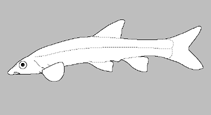
Espinhos dorsais (total) : 0; Raios dorsais (total) : 11; Espinhos anais: 0; Raios anais : 10; Vértebras: 41. Diagnosis: body depth 18-23.2% of standard length (SL); head length 20.3-24.3% SL; snout rounded, wider than long, 26.1-31.5% head length, 94.4-104.3% eye diameter (ED); eye diameter 26.1-30.2% head length; interorbital distance 100-117.4% ED; preorbital distance 38.9-47.8% ED; mouth ventral, wide; lower lip with weakly developed cutting edge; opercular apparatus (only well dveloped in males) consisting of an opercular suction disc followed by a striated, moderately developed postopercular part with about 12 ridges; dorsal and anal fins with 3 unbranched rays; dorsal fin positioned about 0.9-1.1 times closer to tip of snout than to caudal fin origin, inserted at about the same level as pelvic fins; anal fin about halfway pelvic fins and caudal fin origin; pectoral and pelvic fins with a single unbranched ray; pectoral fin 17.3-19.7% SL; body yellowish, dorsal surfaces darker, brownish; dark lateral band not very distinct (Ref. 2970).
Remark: note that the first column in the comparative table in Ref. 2970 (p. 41) contains the morphometrics for K. katangae and the second for K. paucisquamata, contrarily to what is mentioned above the respective columns (T. Musschoot, pers. comm.).
Body shape (shape guide): elongated; Cross section: circular.
Maximum TL was recorded at 5.5 cm (Ref. 2970).
Ciclo de vida ou comportamento de acasalamento
Maturidade | Reprodução | Desova | Ovos | Fecundidade | Larvas
Poll, M., 1984. Kneriidae. p. 129-133. In J. Daget, J.-P. Gosse and D.F.E. Thys van den Audenaerde (eds.) Check-list of the freshwater fishes of Africa (CLOFFA). ORSTOM, Paris and MRAC, Tervuren. Vol. 1. (Ref. 3565)
Status na Lista Vermelha da UICN (Ref. 130435: Version 2025-1)
Ameaça para os humanos
Harmless
Uso pelos humanos
Ferramentas
Relatórios especiais
Baixar XML
Fontes da internet
Estimates based on models
Índice de diversidade filogenética (Ref.
82804): PD
50 = 0.5001 [Uniqueness, from 0.5 = low to 2.0 = high].
Bayesian length-weight: a=0.00389 (0.00180 - 0.00842), b=3.12 (2.94 - 3.30), in cm total length, based on all LWR estimates for this body shape (Ref.
93245).
Fishing Vulnerability (Ref.
59153): Low vulnerability (10 of 100).
🛈