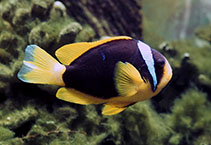
Teleostei (teleosts) >
Ovalentaria/misc (Various families in series Ovalentaria) >
Pomacentridae (Damselfishes) > Pomacentrinae
Etymology: Amphiprion: Greek, amphi = on both sides + Greek, prion, -onos = saw (Ref. 45335).
Eponymy: Jacques Allard had a fish collecting station in Kenya which the aquarist Herbert Axelrod visited. [...] (Ref. 128868), visit book page.
Environment: milieu / climate zone / depth range / distribution range
Ecology
Marine; reef-associated; non-migratory; depth range 1 - 30 m (Ref. 7247). Tropical; 22°C - 27°C (Ref. 130641); 1°S - 30°S, 28°E - 65°E
Western Indian Ocean: Kenya to Durban, South Africa, east to Mauritius.
Size / Weight / Age
Maturity: Lm ? range ? - ? cm
Max length : 15.0 cm TL male/unsexed; (Ref. 9710)
Life cycle and mating behavior
Maturity | Reproduction | Spawning | Eggs | Fecundity | Larvae
Oviparous, distinct pairing during breeding (Ref. 205). Eggs are demersal and adhere to the substrate (Ref. 205). Males guard and aerate the eggs (Ref. 205) deposited in cluster at the base of the sea anemone (Ref. 7471). Also Ref. 240.
Allen, G.R., 1991. Damselfishes of the world. Mergus Publishers, Melle, Germany. 271 p. (Ref. 7247)
IUCN Red List Status (Ref. 130435: Version 2025-2)
Threat to humans
Harmless
Human uses
Fisheries: commercial; aquarium: commercial
Tools
Special reports
Download XML
Internet sources