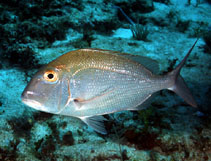
Environment: milieu / climate zone / depth range / distribution range
Ecology
Marine; reef-associated; depth range 3 - 200 m (Ref. 26938). Subtropical; 42°N - 18°S, 98°W - 34°W
Western Atlantic: Rhode Island (USA), Bermuda, and northern Gulf of Mexico southward to Brazil. Most abundant in the West Indies (Ref. 9626).
Length at first maturity / Size / Weight / Age
Maturity: Lm 36.0, range 30 - 42 cm
Max length : 76.0 cm FL male/unsexed; (Ref. 40637); common length : 54.0 cm TL male/unsexed; (Ref. 3815); max. published weight: 10.6 kg (Ref. 4699)
Dorsal spines (total): 12; Dorsal soft rays (total): 12; Anal spines: 3; Anal soft rays: 10. Blue line under each eye. Corner of mouth and isthmus have orange cast (Ref. 26938). An irregular row of small molariform teeth inside and toward the front of the three usual rows of molars at side of upper jaw; dorsal profile of head evenly convex and not very steep (Ref. 13442).
Body shape (shape guide): short and / or deep.
Inhabits coastal waters. Found on vegetated sand bottoms and more frequently on coral bottoms. Occasionally found at depths at least 180m (Ref. 09710) and 200 m. (Ref. 26938). Large adults are usually solitary. Feeds mainly on sea urchins, (including Diadema, Ref. 13442), crabs and mollusks. Excellent food fish (Ref. 5521).
Life cycle and mating behavior
Maturity | Reproduction | Spawning | Eggs | Fecundity | Larvae
Robins, C.R. and G.C. Ray, 1986. A field guide to Atlantic coast fishes of North America. Houghton Mifflin Company, Boston, U.S.A. 354 p. (Ref. 7251)
IUCN Red List Status (Ref. 130435: Version 2025-2)
Threat to humans
Reports of ciguatera poisoning (Ref. 9710)
Human uses
Fisheries: minor commercial; gamefish: yes
Tools
Special reports
Download XML
Internet sources