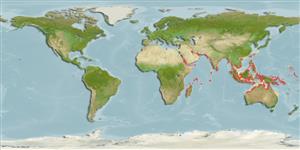
Elasmobranquios (tiburones y rayas) (sharks and rays) >
Myliobatiformes (Stingrays) >
Dasyatidae (Stingrays) > Urogymninae
Etymology: Pateobatis: Combination of Latin 'pateo' for 'lie open, be exposed' and 'batis' for skate, ray or flatfish; referring to the eclectic nature of members of this group.
Eponymy: Dr Pieter Bleeker (1819–1878) was an ichthyologist and army surgeon commissioned (1841) by the Dutch East India Company. [...] (Ref. 128868), visit book page.
More on author: Blyth.
Issue
Former synonym of Pateobatis uarnacoides (both previously under Himantura), but was resurrected as valid species (Ref. 114953).
Environment: milieu / climate zone / rango de profundidad / distribution range
Ecología
marino; salobre bentopelágico; anfidromo (Ref. 51243); rango de profundidad ? - 30 m (Ref. 9840). Tropical
Northern Indian Ocean: Pakistan to Myanmar (but range needs refinement).
Tamaño / Peso / Age
Madurez: Lm ? range ? - ? cm
Max length : 84.0 cm WD macho / no sexado; (Ref. 121648); 112.0 cm WD (female); peso máximo publicado: 21.1 kg (Ref. 121648); peso máximo publicado: 21.1 kg
Enters estuaries (Ref. 4832). Found mainly on muddy bottoms to at least 40 m depth. Most likely to feed on small crustaceans (Ref. 114953). Ovoviviparous (Ref. 50449). Feeds on bottom-living invertebrates (Ref. 68964).
Life cycle and mating behavior
Madurez | Reproducción | Puesta | Huevos | Fecundidad | Larva
Exhibit ovoviparity (aplacental viviparity), with embryos feeding initially on yolk, then receiving additional nourishment from the mother by indirect absorption of uterine fluid enriched with mucus, fat or protein through specialised structures (Ref. 50449). Distinct pairing with embrace (Ref. 205).
Talwar, P.K. and A.G. Jhingran, 1991. Inland fishes of India and adjacent countries. vol 1. A.A. Balkema, Rotterdam. i-liv + 1-541, 1 map (Ref. 4832)
IUCN Red List Status (Ref. 130435: Version 2025-1)
Threat to humans
Venomous
Human uses
Pesquerías: comercial
Herramientas
Special reports
Download XML
Fuentes de Internet
Estimates based on models
Preferred temperature (Referencia
123201): 26.6 - 29.3, mean 28.6 °C (based on 2266 cells).
Phylogenetic diversity index (Referencia
82804): PD
50 = 0.5312 [Uniqueness, from 0.5 = low to 2.0 = high].
Bayesian length-weight: a=0.01023 (0.00486 - 0.02155), b=3.06 (2.87 - 3.25), in cm total length, based on LWR estimates for this (Sub)family-body shape (Ref.
93245).
Nivel trófico (Referencia
69278): 3.5 ±0.5 se; based on size and trophs of closest relatives
Resiliencia (Referencia
120179): Bajo, población duplicada en un tiempo mínimo de 4.5-14 años (Assuming fecundity<100).
Fishing Vulnerability (Ref.
59153): Very high vulnerability (90 of 100).
🛈