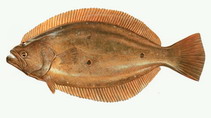
Environment: milieu / climate zone / rango de profundidad / distribution range
Ecología
marino demersal; oceanodromo (Ref. 51243); rango de profundidad 10 - 200 m (Ref. 11230). Subtropical; 62°N - 1°N, 99°E - 163°E (Ref. 54698)
Western Pacific: Japan, Sakhalin, Kuril Islands, Korean Peninsula to the South China Sea.
Length at first maturity / Tamaño / Peso / Age
Madurez: Lm ?, range 40 - ? cm
Max length : 103 cm TL macho / no sexado; (Ref. 40637); peso máximo publicado: 9.1 kg (Ref. 40637)
Espinas dorsales (total) : 0; Radios blandos dorsales (total) : 77 - 81; Espinas anales: 0; Radios blandos anales: 59 - 61; Vértebra: 38.
Body shape (shape guide): fusiform / normal.
Most highly prized of the Japanese flounders.
Distinct pairing (Ref. 205).
Masuda, H., K. Amaoka, C. Araga, T. Uyeno and T. Yoshino, 1984. The fishes of the Japanese Archipelago. Vol. 1. Tokai University Press, Tokyo, Japan. 437 p. (text). (Ref. 559)
IUCN Red List Status (Ref. 130435: Version 2025-1)
Threat to humans
Harmless
Human uses
Pesquerías: muy comercial; Acuicultura: comercial; pesca deportiva: si
Herramientas
Special reports
Download XML
Fuentes de Internet
Estimates based on models
Preferred temperature (Referencia
123201): 8.6 - 25, mean 18.8 °C (based on 241 cells).
Phylogenetic diversity index (Referencia
82804): PD
50 = 0.5000 [Uniqueness, from 0.5 = low to 2.0 = high].
Bayesian length-weight: a=0.00794 (0.00442 - 0.01428), b=3.07 (2.90 - 3.24), in cm total length, based on LWR estimates for this species & (Sub)family-body (Ref.
93245).
Nivel trófico (Referencia
69278): 4.5 ±0.8 se; based on diet studies.
Generation time: 7.3 ( na - na) years. Estimated as median ln(3)/K based on 1
growth studies.
Resiliencia (Referencia
120179): Medio, población duplicada en un tiempo mínimo de 1.4-4.4 años (tm=3; Fec= 3 million).
Fishing Vulnerability (Ref.
59153): High vulnerability (60 of 100).
🛈
Climate Vulnerability (Ref.
125649): Moderate vulnerability (43 of 100).
🛈
Nutrients (Ref.
124155): Calcium = 44.6 [23.3, 90.4] mg/100g; Iron = 0.878 [0.412, 1.545] mg/100g; Protein = 17 [15, 20] %; Omega3 = 0.26 [0.12, 0.50] g/100g; Selenium = 35.6 [18.2, 76.7] μg/100g; VitaminA = 14.5 [4.4, 47.3] μg/100g; Zinc = 0.444 [0.302, 0.644] mg/100g (wet weight); based on
nutrient studies.