Teleostei (teleosts) >
Carangaria/misc (Various families in series Carangaria) >
Polynemidae (Threadfins)
Etymology: Filimanus: Latin, filum = thread + latin, manus = hand (Ref. 45335); heptadactyla: From the Greek hept, meaning seven, and dactyl, finger, in reference to the seven pectoral filaments typically present (Ref. 39607).
More on author: Cuvier.
Environment: milieu / climate zone / depth range / distribution range
Ecology
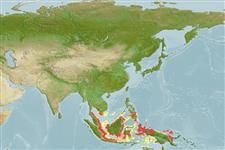
Marine; brackish; demersal. Tropical; 10°N - 11°S, 99°E - 148°E (Ref. 57343)
Western Pacific: Thailand, Malaysia and Indonesia to Papua New Guinea. All records in Indian Ocean are misidentifications for other species: Filimanus similis, Polydactylus mullani, Polydactylus sextarius (Ref. 57343).
Size / Weight / Age
Maturity: Lm ? range ? - ? cm
Max length : 38.0 cm TL male/unsexed; (Ref. 57343)
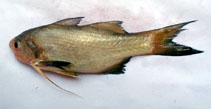
Dorsal spines (total): 9; Dorsal soft rays (total): 12 - 13; Anal spines: 3; Anal soft rays: 11 - 12; Vertebrae: 24. 7 pectoral filaments, third or fourth filament, from ventralmost, the longest, not reaching midpoint of anal fin (Ref. 9685). Body brown above and golden below; fins yellow with black at least at margins; pectorals often mostly black (Ref. 9685).
Body shape (shape guide): fusiform / normal.
Found on open sandflats and muddy substrates (Ref. 57343).
Life cycle and mating behavior
Maturity | Reproduction | Spawning | Eggs | Fecundity | Larvae
Motomura, H., 2004. Threadfins of the world (Family Polynemidae). An annotated and illustrated catalogue of polynemid species known to date. FAO Spec. Cat. Fish. Purp. Rome: FAO. 3:117 p. (Ref. 57343)
IUCN Red List Status (Ref. 130435: Version 2025-2)
Threat to humans
Harmless
Human uses
Fisheries: of no interest
Tools
Special reports
Download XML
Internet sources